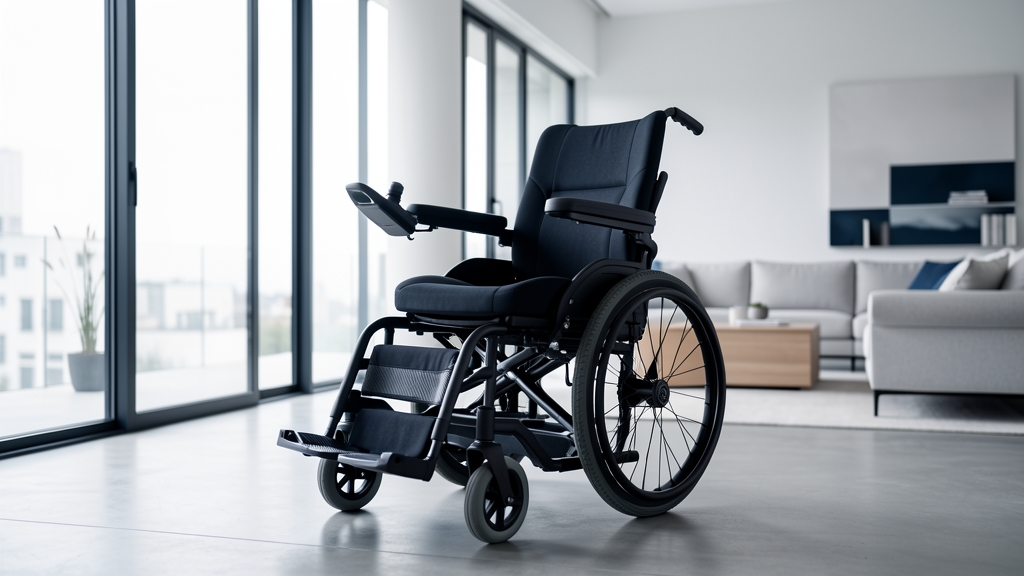
For decades, the technology designed for aging populations has occupied a sterile, utilitarian corner of the consumer electronics market. These devices—clunky walkers, loud medical alerts, and beige plastic pill organizers—were built for function, often at the complete expense of form. They carry a heavy social stigma, acting as visible markers of frailty.
That era is ending. A new wave of high-end "AgeTech" is emerging, driven by a demographic that possesses significant purchasing power and a refusal to compromise on aesthetics or autonomy. This is the rise of luxury senior technology: a sector where carbon fiber, LiDAR, and ambient intelligence converge to create tools that don't just assist, but empower.
The End of the Medical Aesthetic
The shift is visible in the hardware itself. The market is moving away from "medical-grade" toward "consumer-premium." We are seeing a pivot where a mobility aid is designed with the same sleek, minimalist philosophy as a high-end electric vehicle or a flagship smartphone.
This isn't merely about vanity; it is about psychological dignity. When a device—be it an auto-folding wheelchair or a smart walking cane—looks like a piece of high-end industrial design, the user no longer feels like a patient. They feel like a consumer of sophisticated technology.
Mobility: The Robotics Frontier
Perhaps the most dramatic evolution is occurring in personal mobility. The traditional wheelchair is being reimagined through the lens of robotics. New luxury models are incorporating autonomous navigation suites, utilizing LiDAR (Light Detection and Ranging) and computer vision to navigate complex indoor environments without user input.
These devices are no longer just passive seats; they are intelligent companions. Some feature auto-folding mechanisms that allow them to transition from a full-sized mobility solution to a compact, cabin-ready device at the touch of a button. Others are integrating lightweight exoskeleton components, designed to augment muscular strength and provide stability, allowing users to maintain a natural gait.
The technical complexity here is immense. Engineers are solving the "edge case" problems of geriatric mobility: how a device reacts to a sudden change in floor texture, how it identifies a person in its path, and how it maintains battery life while powering high-torque motors.
Ambient Intelligence and the Invisible Caretaker
Beyond physical movement, the most significant technological leap is happening in the environment. The concept of "Ambient Intelligence" (AmI) is replacing the intrusive, camera-based monitoring systems of the past.
The new standard in luxury senior living is touchless and invisible. Instead of cameras that compromise privacy, high-end smart homes are deploying mmWave (millimeter wave) radar sensors. These sensors can detect minute movements, such as the rise and fall of a chest during breathing or the sudden trajectory of a fall, all without capturing a single identifiable image.
This is complemented by a suite of touchless interfaces. From voice-activated environmental controls to sensor-based hygiene dispensers, the goal is to minimize the need for fine motor skills that may decline with age. This "frictionless living" is achieved through a mesh of IoT (Internet of Things) devices that communicate seamlessly, creating a home that anticipates needs rather than just reacting to commands.
The UX of Degeneration
Designing for an aging population presents unique challenges in User Experience (UX). Traditional tech design often assumes perfect vision, high dexterity, and rapid cognitive processing. AgeTech designers are flipping this script.
We are seeing an emphasis on:
* Haptic Feedback: Using tactile vibrations to confirm actions, compensating for diminished tactile sensitivity.
* High-Contrast, Large-Scale Interfaces: Moving beyond the standard smartphone UI to layouts that account for presbyopia and reduced color perception.
* Bone Conduction Audio: Providing clear, private auditory feedback that doesn't require uncomfortable earpieces.
The challenge for manufacturers is to integrate these features without making the product look "specialized." The most successful products are those where the accessibility features are baked into the core design, making them useful for everyone, not just a niche demographic.
The Macroeconomic Shift: The Silver Economy
The business implications are profound. The "Silver Economy"—the economic activity generated by the aging population—is one of the fastest-growing segments in the global tech landscape. As wealth transfers to older generations, the demand for premium, high-reliability technology is skyrocketing.
Investors are no longer looking at AgeTech as a niche social good, but as a massive, untapped high-margin market. Companies that can bridge the gap between sophisticated engineering and elegant, lifestyle-oriented design are positioned to dominate this new frontier.
The intersection of luxury and aging is proving that independence doesn't have to be a struggle against one's body; with the right technology, it can be a seamless, high-tech experience.