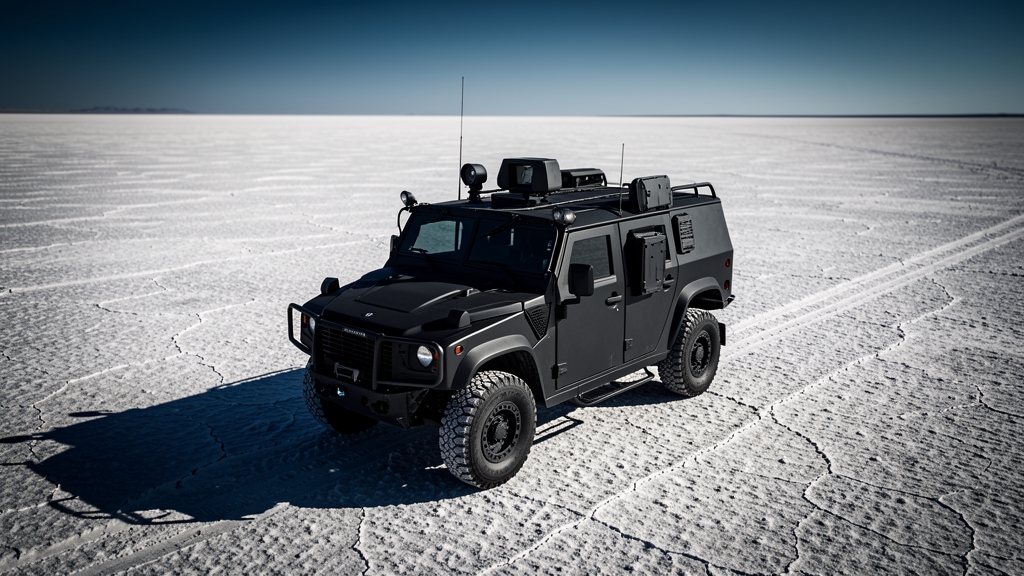
The landscape of global security is undergoing a fundamental metamorphosis. We are moving past the era of heavy armor and traditional kinetic dominance into a period defined by information density, rapid autonomy, and directed energy. The distinction between science fiction and tactical reality is thinning, as breakthroughs in artificial intelligence, material science, and propulsion systems converge to create a new "speed of relevance" in conflict.
This is not merely an incremental upgrade in weaponry; it is a systemic shift in how force is projected, sensed, and managed. From the rugged modularity of tactical vehicles to the invisible precision of quantum sensing, the following seven technological pillars are reshaping the future of defense.
1. The Modular Mobility Revolution: The Polaris Dagor Paradigm
Mobility remains the bedrock of tactical survival, but the requirements are changing. Modern combat environments demand vehicles that are simultaneously lightweight, highly survivable, and technologically integrated. The Polaris Dagor stands as a benchmark for this new requirement.
Unlike traditional heavy infantry vehicles, the Dagor focuses on a high power-to-weight ratio and extreme modularity. It serves not just as a transport, but as a mobile node in a larger digital network. The integration of hybrid-electric drivetrains allows for a reduced thermal and acoustic signature, making it significantly harder for enemy sensors to detect. This shift toward "intelligent mobility" means that vehicles are no longer just platforms for weapons, but active participants in the digital battlespace.
2. Decentralized Intelligence: The Rise of Drone Swarms
The concept of the "single-platform" drone is becoming obsolete. In its place, we see the emergence of swarm intelligence—the ability of hundreds of low-cost, autonomous units to operate as a single, cohesive organism.
These swarms utilize edge computing to make real-time decisions without constant human intervention. By distributing processing power across the entire collective, a swarm can navigate complex environments, overwhelm traditional air defense systems through sheer numbers, and execute coordinated "search and destroy" maneuvers. The strategic implication is massive: the cost of neutralizing a swarm often exceeds the cost of producing it, flipping the traditional economic logic of aerial warfare.
3. Directed Energy Weapons (DEW): The End of the Magazine Limit
For decades, the limitation of missile defense has been the "magazine depth"—the finite number of interceptors a system can fire before it runs out. Directed Energy Weapons (DEW), specifically high-energy lasers, are solving this problem by offering a nearly infinite magazine.
The physics are straightforward but the engineering is Herculean: focusing intense electromagnetic energy to melt or vaporize incoming threats. As solid-state laser technology matures, the cost per shot drops to the price of the electricity used, making it an incredibly efficient countermeasure against cheap loitering munitions and small UAVs. We are witnessing the transition from kinetic interception to energy-based neutralization.
4. Human Augmentation: The Cognitive-Physical Interface
The modern soldier is drowning in data. To combat cognitive overload, the defense industry is investing heavily in Augmented Reality (AR) and exoskeleton technology.
Next-generation combat helmets are evolving into sophisticated Heads-Up Displays (HUDs) that overlay thermal imaging, friend-or-foe identification, and real-time telemetry directly onto the user's field of vision. Simultaneously, powered exoskeletons are being refined to reduce the physical toll of carrying heavy loads, effectively extending the operational endurance of the individual. The goal is a "centaur" model of warfare: the intuition of the human combined with the precision and endurance of the machine.
5. Hypersonic Dominance: Breaking the Interception Barrier
Current missile defense systems are built on the assumption of predictable ballistic trajectories. Hypersonic weapons—traveling at speeds exceeding Mach 5—shatter this assumption.
Unlike ballistic missiles, which follow a high, predictable arc, hypersonic glide vehicles maneuver within the atmosphere, making them nearly impossible to track or intercept with current radar and interceptor technology. This capability drastically compresses the decision-making window for command structures, forcing a total rethink of global early-warning systems and strategic deterrence.
6. Unmanned Ground Vehicles (UGV): The Last-Mile Logistics
The "last mile" of combat—the movement of supplies and reconnaissance through high-threat zones—is perhaps the most dangerous task for any military. Autonomous Ground Vehicles (UGVs) are stepping into this vacuum.
From small, quadrupedal "robot dogs" used for room clearing to large, unmanned logistics trucks capable of navigating treacherous terrain, UGVs are removing humans from the highest-risk roles. These platforms are increasingly integrated with AI-driven navigation, allowing them to operate in GPS-denied environments using visual odometry and LIDAR, ensuring that the supply chain remains unbroken even in the most contested zones.
7. The Quantum Frontier: Sensing and Securing
The final, and perhaps most invisible, frontier is quantum technology. Quantum sensing promises a level of detection that was previously impossible, such as detecting minute changes in gravitational or magnetic fields to find submerged submarines or underground bunkers.
On the communications front, the race for quantum-resistant cryptography is well underway. As quantum computing threatens to render current encryption obsolete, the development of Quantum Key Distribution (QKD) is becoming a strategic necessity to ensure that command-and-control networks remain secure from even the most advanced adversaries.
The Analytical Outlook
The convergence of these technologies suggests a future of "hyper-war"—a state where the tempo of combat is dictated by the speed of algorithms and the efficiency of energy transfer. For tech-driven defense sectors, the challenge is no longer just about building a better machine, but about building a more integrated, faster, and more resilient ecosystem. The battlefield of tomorrow is being coded today.