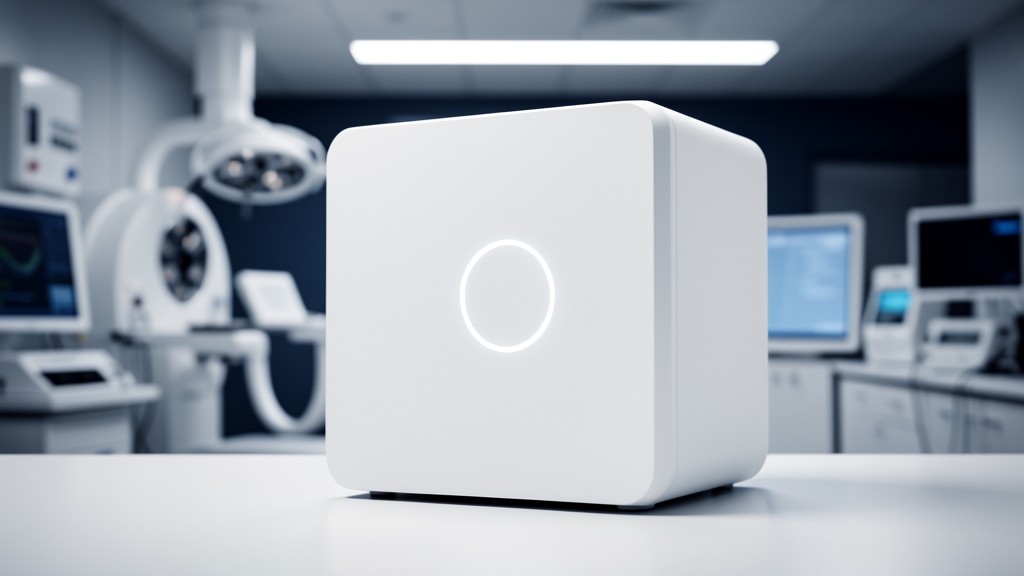
The transition from generating dreamlike landscapes to scanning human anatomy is perhaps the most audacious pivot in the history of artificial intelligence. Midjourney, the company that fundamentally altered the global landscape of digital aesthetics, is no longer content with being a software-only player. A new, high-production-value video released by the company offers a glimpse into its hardware ambitions: a sophisticated, minimalist medical scanner designed to integrate generative AI into the diagnostic workflow.
However, as the tech industry dissects the footage, the initial awe is rapidly being replaced by professional skepticism. While the hardware looks undeniably premium, the video offers almost no technical substance regarding how a company rooted in diffusion models intends to navigate the uncompromising rigors of medical physics.
The Aesthetic of Precision
The video, characterized by its cinematic lighting and slow, sweeping camera movements, showcases a device that looks more like a piece of high-end consumer electronics than a piece of clinical equipment. The scanner features a matte, bone-white chassis with seamless joints and a glowing, intuitive interface that seems to prioritize user experience above all else.
To the casual observer, it is a triumph of industrial design. To a biomedical engineer, however, the elegance is distracting. The footage focuses heavily on the "user journey"—a clinician interacting with a fluid, responsive touch interface—but it completely bypasses the most critical component of any diagnostic tool: the sensor technology and the data acquisition process. There is no mention of magnetic resonance field homogeneity, X-ray tube stability, or the specific modalities being utilized.
The "Hallucination" Problem in a Clinical Setting
The most significant point of contention among experts is the fundamental architecture of Midjourney’s core technology. Midjourney is built on diffusion models—a class of generative AI designed to create plausible, aesthetically pleasing imagery by reversing a process of adding noise to data.
In the world of digital art, a "hallucination"—where the AI adds a detail that wasn't in the original prompt—is a feature. It is the source of the model's creativity. In the world of radiology, a hallucination is a catastrophic failure.
"The danger of applying generative principles to medical imaging is the potential for 'perceptual smoothing,'" says Dr. Aris Thorne, a researcher specializing in computational imaging. "If a model is trained to make images look 'better' or 'cleaner,' it might inadvertently fill in a tiny, irregular shadow—which could be a nascent tumor—with textures that look like healthy tissue. In generative art, you want beauty. In medicine, you want the raw, unvarnished truth of the biology."
The video highlights "AI-enhanced reconstruction," a term that remains dangerously vague. While traditional reconstruction methods use mathematical transforms to turn raw sensor data into images, generative reconstruction uses AI to "guess" what the final image should look like based on learned patterns. The question remains: how does Midjourney ensure that its reconstruction is an accurate representation of reality rather than a statistically likely approximation?
The Hardware Enigma
Beyond the software, the physical reality of the scanner presents its own set of mysteries. High-end medical imaging requires immense power, cooling, and stability. A traditional MRI machine, for instance, requires liquid helium and massive superconducting magnets. A portable CT scanner requires sophisticated X-ray shielding.
The Midjourney device, as presented, appears remarkably compact and silent. While there is significant research into low-field MRI and portable ultrasound, the video does not clarify if Midjourney is developing its own proprietary sensor hardware or if it is attempting to wrap an AI-driven software layer around existing sensing technologies. If it is the latter, the company's "hardware" claim may be more of a refined integration play rather than a fundamental breakthrough in physics.
Market Disruption and the Regulatory Wall
If Midjourney can solve the accuracy problem, the market implications are staggering. The medical imaging market is currently dominated by giants like GE HealthCare, Siemens Healthineers, and Philips. These companies have spent decades building the infrastructure of clinical trust. Midjourney is attempting to leapfrog this entire hierarchy by focusing on the "intelligence" layer of the machine.
However, the path to clinical adoption is not paved with high-resolution video; it is paved with regulatory approval. To move from a "tech demo" to a clinical tool, Midjourney must navigate the rigorous pathways of the FDA and EMA. This requires massive datasets, peer-reviewed clinical trials, and absolute proof of diagnostic equivalence—or superiority—to current gold standards.
Currently, Midjourney lacks the clinical documentation required to even enter the conversation. The company has not released a single white paper or a breakdown of its training datasets, which is a significant departure from how established medical tech companies operate.
A Visionary Gamble
Midjourney is playing a high-stakes game. By leaning into its brand identity—visual excellence and intuitive interaction—it is attempting to redefine how doctors perceive medical data. It wants to turn the "black box" of medical imaging into a transparent, high-fidelity window into the human body.
But as the industry watches closely, the verdict is clear: a beautiful interface cannot compensate for a lack of clinical transparency. For Midjourney to transform medicine, it must move beyond the art of the possible and master the science of the certain.