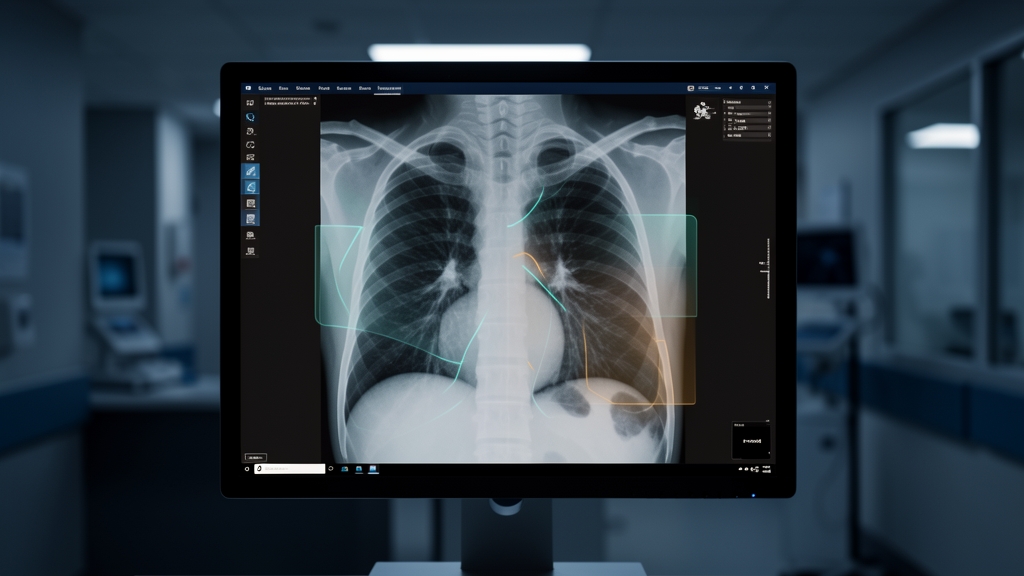
The bottleneck in modern healthcare is rarely a lack of data; it is the speed at which that data can be interpreted. As medical imaging volumes swell globally, radiologists find themselves caught in a high-pressure cycle of increasing caseloads and decreasing turnaround times. The industry has long looked to artificial intelligence to alleviate this pressure, but until now, most AI interventions have functioned as "triage assistants"—tools that flag an abnormality but leave the heavy lifting of documentation to the human expert.
Aidoc is attempting to change that fundamental dynamic. In a significant move that signals the next evolution of medical AI, the company is developing a sophisticated feature capable of not only detecting irregularities in chest X-rays but also generating preliminary clinical reports covering more than 100 different findings.
Beyond the Red Box: The Shift to Interpretive AI
To understand the magnitude of this development, one must distinguish between the two primary stages of AI in radiology: detection and interpretation.
Most current AI tools in the diagnostic space focus on detection. They use computer vision to identify a specific pattern—a lung nodule, a pleural effusion, or a collapsed lung—and often highlight it with a digital bounding box or a color-coded overlay on a radiologist's screen. While this "triage" model is highly effective at ensuring critical cases move to the top of the queue, it does not reduce the actual clerical workload of the physician. The radiologist still must examine the image, confirm the finding, and then manually type a structured or narrative report.
Aidoc’s new initiative targets the latter stage: the reporting. By leveraging advanced Natural Language Generation (NLG) alongside high-fidelity computer vision, the system aims to bridge the gap between seeing an anomaly and communicating it. This isn't just about flagging a problem; it is about describing it in clinical terms that are immediately usable in a patient's medical record.
The Complexity of 100+ Findings
The scale of this undertaking is immense. Generating a report for a single, obvious pathology is a solved problem in many research environments. However, the human chest is a crowded anatomical landscape. A single X-ray can contain evidence of:
* Cardiovascular issues: Such as cardiomegaly (enlarged heart) or changes in the aortic knob.
* Pulmonary pathologies: Including pneumonia, pulmonary edema, pneumothorax, or pleural effusions.
* Structural abnormalities: Such as rib fractures, spinal misalignment, or lung volume changes.
* Subtle findings: Bone density variations or minor pleural thickening.
To cover more than 100 findings requires a model that possesses an extraordinary level of granularity. It is not enough for the AI to say "something is wrong in the left lung"; it must be able to distinguish between a localized infection and a broader fluid accumulation, and then communicate that distinction with the nuance required by medical professionals.
The Technical Frontier: Vision Meets Language
The underlying technology driving this breakthrough represents a convergence of two massive fields in artificial intelligence: Computer Vision (CV) and Large Language Models (LLMs).
For years, these fields operated in silos. CV models were excellent at spatial recognition—identifying where a pixel pattern sat in a three-dimensional context. LLMs were masters of syntax and semantics—understanding how words relate to one another. Aidoc’s challenge lies in the "grounding" of language in visual evidence. In a medical context, a "hallucination"—the tendency for generative models to confidently state facts that are not true—is not merely a technical glitch; it is a clinical liability.
The goal is to create a "multimodal" architecture where the visual features extracted from the X-ray directly dictate the linguistic structure of the report. This ensures that the generated text is a faithful representation of the pixels, rather than a probabilistic guess based on common medical phrases.
Market Impact and the Workflow Revolution
If successfully integrated, this technology could fundamentally rewrite the economics of a radiology department. The current model is labor-intensive, and the shortage of trained radiologists is a growing global crisis. By automating the "preliminary report," Aidoc is proposing a workflow where the radiologist shifts from a creator of reports to an editor of reports.
Instead of starting with a blank screen, the clinician opens a study to find a draft already waiting. They review the AI's findings, correct any inaccuracies, and sign off. This could theoretically slash the time spent on routine, high-volume X-rays, allowing specialists to dedicate more cognitive energy to complex, multi-modality cases like MRI or CT scans that require higher-order reasoning.
The Road Ahead: Trust, Regulation, and Liability
Despite the technical promise, the path to widespread clinical adoption is fraught with hurdles.
First, there is the regulatory gauntlet. Moving from a "triage" tool (which helps a doctor work faster) to a "reporting" tool (which suggests what a doctor should say) significantly raises the bar for FDA and EMA scrutiny. Regulatory bodies will require rigorous validation to ensure that the AI's "preliminary findings" are both sensitive enough to catch nothing, and specific enough to avoid false positives.
Second, there is the question of professional trust. Radiologists are trained to be skeptical. For an AI to become a standard part of the workflow, it must prove its reliability over millions of iterations. A single high-profile error where an AI "misses" a finding or mischaracterizes a critical condition could set the technology back years in terms of clinician sentiment.
Finally, the industry must grapple with the legal nuances of liability. If a physician signs off on an AI-generated report that contains a subtle error, where does the blame lie? The software provider? The hospital? The physician?
Aidoc’s foray into automated reporting is a bold bet on the future of the "augmented clinician." It moves the conversation away from whether AI can assist doctors, and toward how much of the clinical cognitive load we are willing to delegate to machines.