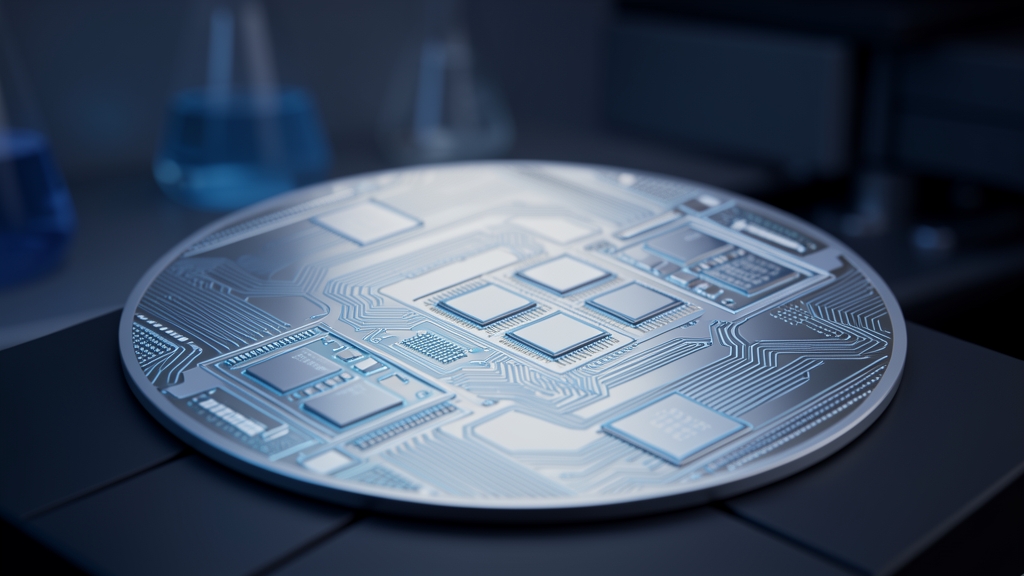
The race for artificial intelligence dominance is no longer being fought solely in the realm of code and parameters; it has moved decisively into the physical layer of silicon. Alphabet’s stock is seeing a significant surge this morning following reports that the company is nearing a breakthrough with its next-generation AI accelerator, dubbed "Frozen v2."
Unlike previous iterations of Tensor Processing Units (TPUs) that served as high-performance, general-purpose engines for machine learning workloads, Frozen v2 represents a fundamental shift in computing philosophy. According to internal reports, this new chip intends to do something far more radical: embed specific components of the Gemini model’s architecture directly into the hardware circuitry.
The Death of the General-Purpose Bottleneck
For the past several years, the AI industry has relied heavily on the "brute force" method—scaling up massive, general-purpose GPUs to handle increasingly complex transformer models. While effective, this approach suffers from the traditional Von Neumann bottleneck, where the constant movement of data between the memory and the processor creates massive latency and energy waste.
Frozen v2 seeks to bypass this limitation through hardware-software co-design. By understanding the mathematical "shape" of Gemini’s neural networks, Alphabet engineers are designing circuits that mirror the specific ways Gemini processes information. This means that instead of the software telling a generic processor how to execute an operation, the processor is physically built to perform those specific operations with minimal instruction overhead.
This level of vertical integration is reminiscent of Apple’s transition to its own M-series silicon, but applied to the vastly more complex and fluid landscape of large language models (LLMs).
Hardware-Level Attention Mechanisms
The most technical—and most significant—claim regarding Frozen v2 involves the optimization of the "attention mechanism," the mathematical engine that allows Gemini to understand context and relationships within data.
In standard hardware, calculating attention requires massive amounts of memory bandwidth and complex matrix multiplications. Reports suggest that Frozen v2 may utilize specialized, on-chip logic gates dedicated specifically to these attention computations. By hardcoding the logic for specific transformer layers into the silicon, Alphabet can potentially achieve several orders of magnitude improvements in both throughput and energy efficiency.
Key technical advantages of this approach include:
* Reduced Data Movement: By placing the logic closer to the weights, the chip minimizes the distance data must travel, slashing power consumption.
* Deterministic Latency: Specialized circuits provide more predictable processing times, a critical requirement for real-time AI agents and voice-based interactions.
* Optimized Memory Management: The chip can prioritize the specific memory access patterns used by Gemini, effectively creating a "smart" cache that anticipates the model's next move.
The Economic Moat: Reducing the NVIDIA Tax
The market’s enthusiastic reaction to the news is deeply tied to the economics of the AI era. Currently, the industry is characterized by an immense "NVIDIA tax"—the high cost of acquiring and running the high-end GPUs required to train and serve frontier models.
If Alphabet successfully deploys Frozen v2, it moves closer to a state of total vertical integration. By owning the model (Gemini), the software ecosystem (Google Cloud), and the physical hardware (Frozen v2), Alphabet can drive down the cost of inference—the process of actually running the AI for users—to levels that competitors relying on third-party hardware may struggle to match.
This efficiency doesn't just improve margins; it expands the total addressable market. If running a high-reasoning model becomes ten times cheaper and uses a fraction of the power, AI becomes viable for edge devices, mobile integration, and massive-scale industrial applications that were previously cost-prohibitive.
The Risk of Rigidity
However, the move toward specialized silicon is not without significant risk. The primary danger is "architectural ossification."
The field of AI research moves at a breakneck pace. Today, the transformer architecture is the undisputed king, but the history of computer science is littered with specialized chips that became obsolete overnight because a new, more efficient mathematical approach emerged. If Frozen v2 is too tightly coupled to the current version of Gemini, it risks becoming an expensive piece of "dead silicon" if the next breakthrough in AI involves moving away from transformer-based models.
Alphabet is essentially placing a massive, high-stakes bet: they are wagering that the current trajectory of Gemini’s architecture is stable enough to justify the immense capital expenditure required to bake its logic into physical matter.
A New Era of Computing
As the industry watches closely, the implications of the Frozen v2 report extend beyond a single company. It signals a broader trend in the semiconductor industry where the line between "software company" and "chip company" is blurring into non-existence.
We are entering an era where the most powerful AI will not be the one with the most parameters, but the one that most efficiently reconciles its mathematical soul with its physical body. Alphabet’s attempt to achieve this symbiosis could well define the next decade of the computational landscape.