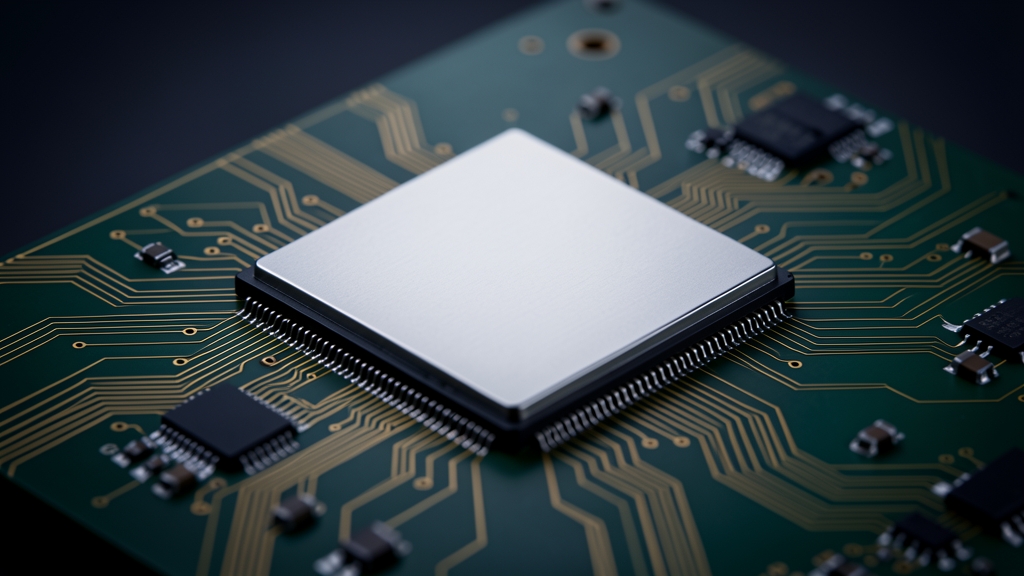
The battle for artificial intelligence has long been fought in the massive, liquid-cooled halls of data centers. But a new front is opening—one that is much smaller, much faster, and significantly more mobile. AMD is officially entering this fray with the announcement of its Ryzen AI X100 embedded processors, a strategic pivot that signals the company's intent to dominate the "Edge AI" landscape.
For years, the industry standard for high-performance edge computing—particularly in robotics—has been dominated by specialized modules that often require a delicate balance of discrete components. AMD’s latest move seeks to disrupt this equilibrium by offering a highly integrated solution that brings heavy-duty neural processing power directly to the hardware level of autonomous machines.
The Architecture of Autonomy
At the heart of the Ryzen AI X100 series is the integration of AMD's specialized XDNA architecture. Unlike traditional processors that rely heavily on the CPU for general tasks or a discrete GPU for heavy lifting, the X100 utilizes a dedicated Neural Processing Unit (NPU). This NPU is specifically engineered to handle the massive, repetitive mathematical workloads required by machine learning models, doing so with a fraction of the power consumption of a traditional GPU.
In the context of robotics, this efficiency is not just a luxury; it is a fundamental requirement. A mobile robot operating on battery power cannot afford the thermal overhead or the massive energy drain of a power-hungry desktop-class chip. The X100 is designed to solve this specific friction point, providing the "intelligence-per-watt" necessary for real-time decision-making without compromising operational longevity.
Key technical advantages of the X100 architecture include:
* Localized Inference: By processing AI workloads on the chip itself, devices can respond to environmental stimuli in milliseconds, bypassing the latency issues inherent in cloud-based processing.
* Heterogeneous Computing: The seamless interplay between the CPU, GPU, and NPU allows for complex multitasking—such as managing motor controls via the CPU while simultaneously running computer vision algorithms via the NPU.
* Enhanced Privacy and Security: Processing data locally means sensitive environmental data from a factory floor or a home environment never needs to leave the device, mitigating cybersecurity risks.
Challenging the Incumbents
The announcement puts AMD on a direct collision course with established players, most notably NVIDIA. For a long time, NVIDIA’s Jetson platform has been the gold standard for developers building AI-driven robots. NVIDIA’s strength lies in its CUDA software ecosystem, which has become a massive moat, making it the default choice for most machine learning engineers.
However, AMD is betting that a more versatile, integrated approach will appeal to a different segment of the market: the industrial OEM (Original Equipment Manufacturer). While NVIDIA excels in specialized, high-end AI modules, AMD’s Ryzen AI X100 offers a more holistic computing platform. For companies building complex industrial IoT (IIoT) devices or sophisticated service robots, the ability to use a single, highly capable silicon package for both general-purpose logic and AI inference simplifies the hardware design process and reduces the Bill of Materials (BOM).
Intel, too, remains a formidable competitor in the embedded space with its Core Ultra and Atom-based lines. But AMD's aggressive focus on the XDNA NPU architecture suggests they are aiming specifically at the high-performance end of the edge spectrum, where the complexity of the AI models exceeds what standard low-power chips can manage.
Real-World Impact: From Warehouses to Smart Cities
The implications of the Ryzen AI X100 extend far beyond the laboratory. In the logistics sector, we are seeing a transition from simple, programmed AGVs (Automated Guided Vehicles) to fully autonomous mobile robots (AMRs) capable of navigating dynamic, human-centric environments. These robots require constant "vision"—the ability to interpret depth, recognize obstacles, and predict human movement—all of which are tasks the X100 is built to accelerate.
In industrial automation, the "predictive maintenance" revolution relies on edge intelligence. Sensors equipped with X100-class processors can analyze vibration and heat patterns in real-time, identifying a failing bearing before it causes a catastrophic line stoppage. This moves the industry from reactive repairs to proactive, intelligent management.
Furthermore, as "Smart City" infrastructure continues to expand, the need for edge-processed intelligence in traffic management, public safety, and utility monitoring will skyrocket. The X100 provides the computational backbone required for these localized, high-stakes environments.
The Software Hurdle
Despite the hardware's promise, AMD faces a significant hurdle: the software stack. Hardware is only as good as the tools available to write code for it. To truly challenge the status quo, AMD must ensure that developers can easily port their existing models—often trained on NVIDIA-centric frameworks—to the Ryzen AI architecture.
The success of the X100 will likely depend on the maturity of AMD’s ROCm (Radeon Open Compute) and other software abstraction layers. If AMD can make the transition seamless for developers, the Ryzen AI X100 won't just be another chip in the market; it will be the engine driving the next generation of autonomous machines.
As the industry moves toward a future where intelligence is no longer something we "call upon" from a server, but something that lives within the very objects around us, AMD has placed a significant bet on being the foundation of that reality.