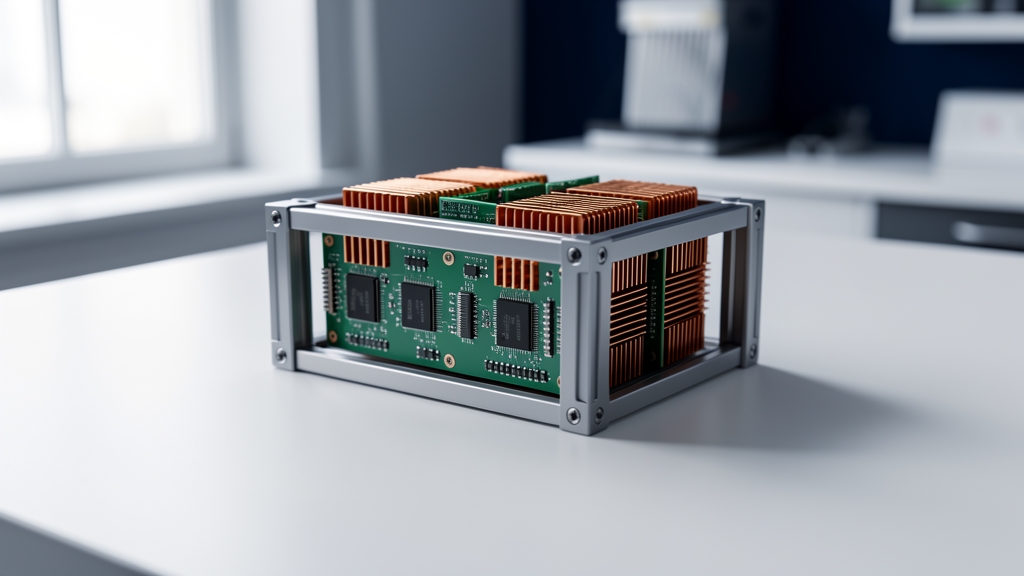
The boundary between the digital intelligence of Large Language Models (LLMs) and the physical constraints of hardware engineering is blurring. In a move that underscores the growing utility of generative AI in industrial workflows, technical staff at Anthropic are reportedly using Claude to design and engineer a custom rack system specifically for Framework mainboards.
This isn't merely a hobbyist project or a clever coding exercise; it represents a significant leap in the application of "reasoning-based" AI. While LLMs have long been celebrated for their ability to write prose or debug Python, the leap to spatial reasoning and mechanical design marks the beginning of a new era: the era of AI-augmented physical prototyping.
The Convergence of Two Disruptors
To understand the significance of this development, one must look at the two entities involved. Anthropic, a leader in the AI safety and intelligence space, is pushing the boundaries of what Claude can do beyond text. Framework, the champion of modular, repairable computing, provides the perfect canvas for this experimentation.
Framework mainboards are highly versatile, decoupled components that allow users to build custom computing solutions without being tied to a proprietary laptop chassis. By designing a rack for these boards, Anthropic's engineers are essentially creating a modular, high-density compute cluster—a DIY server rack that can be scaled and customized with unprecedented ease.
The choice of Framework hardware is no accident. The modularity of the mainboards mirrors the modularity of the AI's logic; both systems are designed to be deconstructed, repurposed, and optimized through iterative logic.
The Mechanics of AI-Driven CAD
How does an LLM, primarily trained on vast datasets of human language, contribute to a physical rack design? The answer lies in the transition from natural language to structured geometric data.
The process likely bypasses traditional, manual CAD (Computer-Aided Design) workflows in favor of a more fluid, generative approach. Rather than clicking through complex interfaces in SolidWorks or Fusion 360, engineers can interact with Claude to define constraints, dimensions, and thermal requirements.
The technical pipeline likely follows this trajectory:
* Constraint Definition: Engineers provide high-level parameters—number of mainboards, airflow requirements, power supply placement, and mounting standards.
* Algorithmic Generation: Claude processes these constraints, potentially generating code for parametric modeling tools like OpenSCAD or Python scripts for Blender.
* Iterative Refinement: Through a feedback loop, the engineer can tell the AI, "The heat dissipation on the third slot is insufficient; adjust the vent geometry," and the model recalculates the spatial arrangement.
* File Export: The final output is a clean, manufacturable file ready for 3D printing or CNC machining.
This shifts the role of the engineer from a "drafter" to a "system architect." The AI handles the tedious geometry and spatial optimization, while the human focuses on the high-level intent and structural integrity.
The "Physical AI" Paradigm Shift
This development is a precursor to what many in the industry call "Physical AI." For years, the bottleneck for AI has been its "body." An AI can solve a complex mathematical proof, but it cannot, on its own, design the housing that protects the server it runs on.
By using Claude to tackle a mechanical engineering problem, Anthropic is demonstrating that the "reasoning" capabilities of modern LLMs are transferable to the physical world. If an AI can understand the structural implications of a rack design, it can eventually understand the nuances of electrical engineering, thermal dynamics, and material science.
The implications for rapid prototyping are massive. In a traditional hardware development cycle, a design error can cost weeks of lead time. With an AI-integrated workflow, the "design-test-fail-fix" loop happens in seconds, significantly lowering the barrier to entry for custom hardware development.
Market Impact and the DIY Revolution
The intersection of modular hardware like Framework and intelligent design agents like Claude is poised to disrupt several sectors:
1. Edge Computing: Small-scale, highly efficient, custom-built server clusters will become more accessible to researchers and small businesses.
2. Rapid Prototyping Services: Engineering firms may move toward "AI-first" design workflows, reducing overhead and increasing the speed of product development.
3. The Maker Economy: For high-end enthusiasts, the ability to describe a complex mechanical part and receive a print-ready file removes one of the steepest learning curves in modern manufacturing.
However, challenges remain. Spatial reasoning in LLMs is still an evolving field, and "hallucinations"—the tendency for AI to confidently state incorrect information—could manifest as catastrophic structural flaws in a physical object. The requirement for rigorous human verification remains paramount.
As Anthropic engineers continue to experiment with these tools, the industry is watching closely. We are witnessing the moment where the "brain" in the machine begins to help build the machine itself.