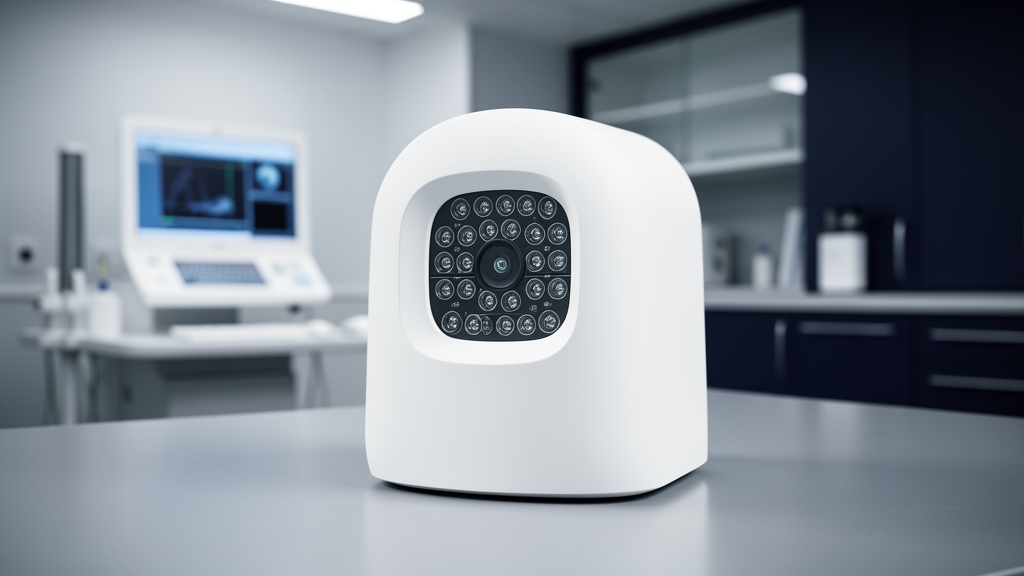
The financial markets are witnessing a rare moment of convergence where the worlds of generative art and clinical diagnostics collide. Butterfly Network (BFLY), a pioneer in semiconductor-based ultrasound technology, is seeing its stock price surge to a four-year high following a revelation that has stunned both Silicon Valley and Wall Street: the AI powerhouse Midjourney is utilizing Butterfly’s components to power a new breed of medical hardware.
The announcement came via a technical deep-dive from Midjourney, which showcased a prototype for a full-body tomographic imaging machine. While the company is best known for its text-to-image generative models, this move signals a massive pivot toward "physical AI"—the application of generative vision models to reconstruct real-world, three-dimensional biological data.
The Technical Marriage: Generative Vision Meets Silicon Ultrasound
At the heart of this breakthrough is a sophisticated interplay between sensor hardware and algorithmic reconstruction. Traditional tomographic imaging—such as CT or MRI—requires massive, expensive machinery and significant power consumption. Midjourney’s prototype aims to disrupt this by using a distributed array of sensors powered by Butterfly Network’s "ultrasound-on-a-chip" technology.
Butterfly Network has spent years perfecting its CMOS-based transducer technology. Unlike traditional ultrasound machines that rely on bulky piezoelectric crystals, Butterfly uses silicon-based technology, allowing for high-performance imaging to be shrunk onto a single chip. This makes the sensors incredibly scalable, lightweight, and, crucially, digitally compatible with the high-throughput processing required by advanced AI models.
The integration works like this: Butterfly’s components capture raw acoustic data from the body. This data is then fed into Midjourney’s proprietary generative vision engines. Rather than simply displaying a grainy ultrasound image, Midjourney’s models act as a "super-resolution" layer, predicting and reconstructing missing volumetric data to create a high-fidelity, three-dimensional tomographic map of the patient’s internal anatomy.
Why Midjourney? The Logic of Latent Space
To the uninitiated, Midjourney’s foray into medical imaging might seem tangential. However, for AI researchers, the connection is profound. Midjourney’s core competency lies in its understanding of "latent space"—the mathematical representation of how visual elements relate to one another. Their models have a deep, structural understanding of what objects, textures, and forms look like from every conceivable angle.
By applying these generative principles to medical data, Midjourney is attempting to solve one of the hardest problems in imaging: the reconstruction of high-resolution volumes from sparse or low-quality sensor input. In essence, they are using their ability to "imagine" coherent visual structures to fill in the gaps left by miniaturized, handheld sensors.
Market Impact and the "Embodied AI" Rally
The reaction from investors has been immediate and decisive. Butterfly Network’s stock has climbed sharply, reflecting a broader market re-evaluation of the company's value proposition. No longer viewed merely as a provider of handheld tools for emergency physicians, BFLY is now being positioned as a foundational hardware layer for the next generation of AI-driven diagnostic platforms.
This rally highlights a shifting sentiment in the tech sector. The "AI bubble" concerns often center on software-only companies that lack tangible utility. However, the Midjourney-Butterfly connection provides a blueprint for "Embodied AI"—intelligence that is grounded in physical hardware and interacts directly with the biological world. This synergy creates a moat that is much harder to replicate than a simple software API.
The Hurdles: Regulation and the "Black Box" Problem
Despite the technical excitement, significant challenges remain. The path from a prototype to a clinically validated medical device is paved with regulatory scrutiny. The FDA and other global health authorities require rigorous proof that an AI’s "reconstruction" of an image is an accurate representation of biological reality and not a "hallucination"—a term well-known in the generative AI community.
If an AI model "predicts" the shape of a tumor based on its training data rather than the actual sensor input, the clinical implications could be catastrophic. This "black box" problem—where it is difficult to trace exactly how an AI arrived at a specific visual output—remains the primary barrier to the widespread adoption of generative models in diagnostic medicine.
Midjourney and Butterfly will likely need to move toward "interpretable AI" models, where the reconstruction process can be audited and verified against raw sensor data in real-time.
The Future of Diagnostic Ubiquity
If Midjourney successfully navigates the regulatory landscape, the implications for global healthcare are transformative. We are looking at the possibility of high-resolution, full-body imaging that is portable, relatively inexpensive, and capable of being deployed in remote or resource-limited settings.
The era of the massive, room-sized scanner may be facing its first real challenge. As the line between generative art and generative science continues to blur, the hardware that makes this vision possible—led by innovators like Butterfly Network—will become the most valuable real estate in the technology ecosystem.