The Hardware-Software Paradox: Why Physical Infrastructure is the Silent Backbone of Modern Warfare
In the current geopolitical climate, the discourse surrounding modern warfare is dominated by the ethereal: artificial intelligence, hypersonic glide vehicles, autonomous drone swarms, and cyber-kinetic operations. The narrative suggests a battlefield that is increasingly digital, decentralized, and detached from the heavy iron of the past. However, a significant strategic pivot is underway, one that reminds us of a fundamental truth in military science—software cannot move without hardware, and high-tech platforms cannot operate without the physical arteries of logistics.
Defense Minister Rajnath Singh has brought this reality to the forefront, asserting that even as advanced weapons and cutting-edge platforms are inducted into the armed forces, critical infrastructure such as ports, roads, and tunnels remains indispensable. This is not merely a call for more concrete; it is a recognition of the "Hardware-Software Paradox" in modern defense: the more sophisticated our digital tools become, the more reliant we are on the physical robustness of our supply chains.
The Logistics-as-a-Weapon Doctrine
For decades, military theorists have argued that "amateurs study tactics, but professionals study logistics." In the context of the evolving nature of warfare, this adage is being redefined through a technological lens. The induction of advanced platforms—such as fifth-generation fighter jets or long-range missile systems—requires a level of logistical precision that far exceeds the requirements of previous generations.
These assets are not standalone entities. They are nodes in a massive, complex ecosystem. A high-altitude sensor array requires stable power grids and high-bandwidth data links, which in turn require physical security and accessible maintenance routes. A fleet of autonomous combat vehicles is useless if the rugged terrain of a border region remains impassable for the heavy-duty transport vehicles needed to deploy them.
The strategic emphasis on ports, roads, and tunnels is a move toward "Integrated Logistics." By strengthening these physical assets, a nation effectively increases its "operational tempo"—the speed at which it can move, deploy, and sustain forces. In a high-intensity conflict, the side that can transition from a state of peace to a state of mass mobilization the fastest often holds the decisive advantage.
The Convergence of Civil Engineering and Digital Warfare
The modern interpretation of infrastructure is shifting from static assets to "smart" ecosystems. We are entering an era where the distinction between civil engineering and military technology is blurring. The next generation of border infrastructure is expected to be "digitally enabled."
* Smart Road Networks: Future logistics corridors will likely incorporate embedded sensor technology to monitor structural integrity and real-time traffic flow, allowing for the automated movement of heavy convoys.
* Automated Port Logistics: To handle the rapid influx of heavy weaponry, ports must evolve into highly automated hubs capable of rapid offloading and sorting through integrated AI-driven management systems.
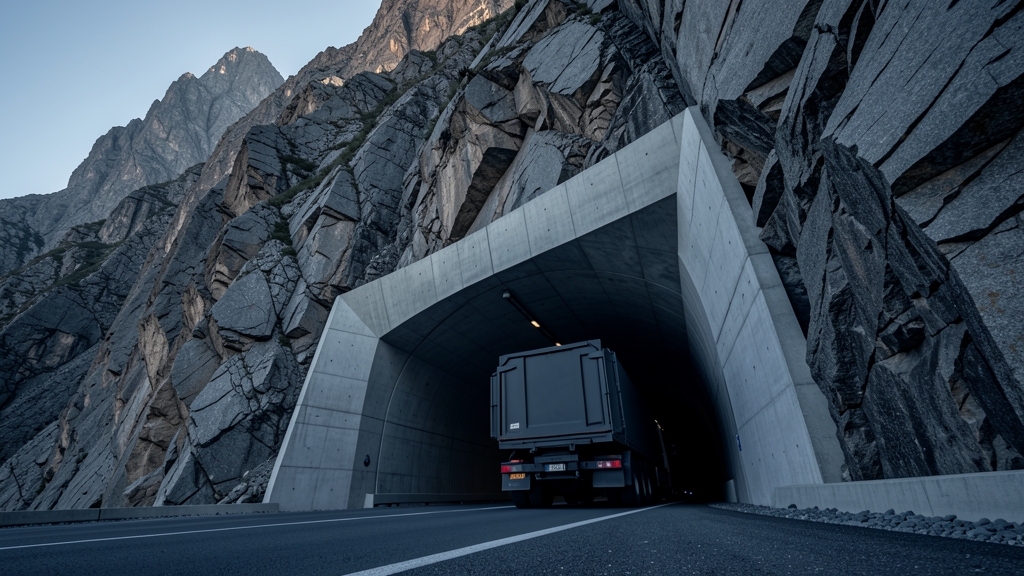
* Hardened Tunnel Systems: Tunnels are no longer just transit points; they are becoming vital tactical assets. Modern tunnel engineering focuses on high-capacity throughput, integrated communication nodes, and resilience against kinetic strikes.
By integrating IoT (Internet of Things) and real-time data analytics into these physical structures, the "fog of war" is mitigated. Command centers can gain a granular view of their supply lines, predicting bottlenecks before they occur and rerouting assets dynamically.
The Last Mile Problem in High-Altitude Conflict
One of the most significant technical challenges highlighted by this strategic shift is the "last mile" problem. In high-altitude and rugged border terrains, the complexity of deploying technology increases exponentially. Signal propagation is often interrupted by mountainous topography, and extreme thermal fluctuations can degrade both electronic components and the very roads they travel on.
Infrastructure serves as the stabilizer for these technical vulnerabilities. A well-engineered road allows for the rapid deployment of mobile signal repeaters and power generation units, which are essential to maintaining the "digital umbrella" required for modern combat. Without these physical lifelines, the most advanced drone or satellite link becomes a stranded asset.
Furthermore, the physical fortification of borders through tunnels and roads acts as a deterrent. It signals a capacity for rapid response that complicates an adversary's calculus. When infrastructure is robust, the "reaction time" for a defending force shrinks, forcing an aggressor to account for a much higher level of immediate logistical readiness.
Geopolitics of the Built Environment
The focus on infrastructure is also a direct response to the shifting geopolitics of the region. As neighboring powers invest heavily in their own dual-use infrastructure—civilian projects that can be rapidly converted for military use—the necessity for a reciprocal buildup becomes a matter of national security.
This is not just about building roads; it is about building a capability. The ability to sustain high-tech warfare in extreme environments is a feat of integrated engineering. It requires a synthesis of heavy industry, digital connectivity, and strategic planning.
As we look toward the future of defense, the headline won't just be about the newest AI algorithm or the fastest missile. It will be about the quiet, heavy-duty efficiency of the tunnels, ports, and roads that make those breakthroughs possible. In the modern era, the most powerful weapon in the arsenal might just be a well-engineered supply line.