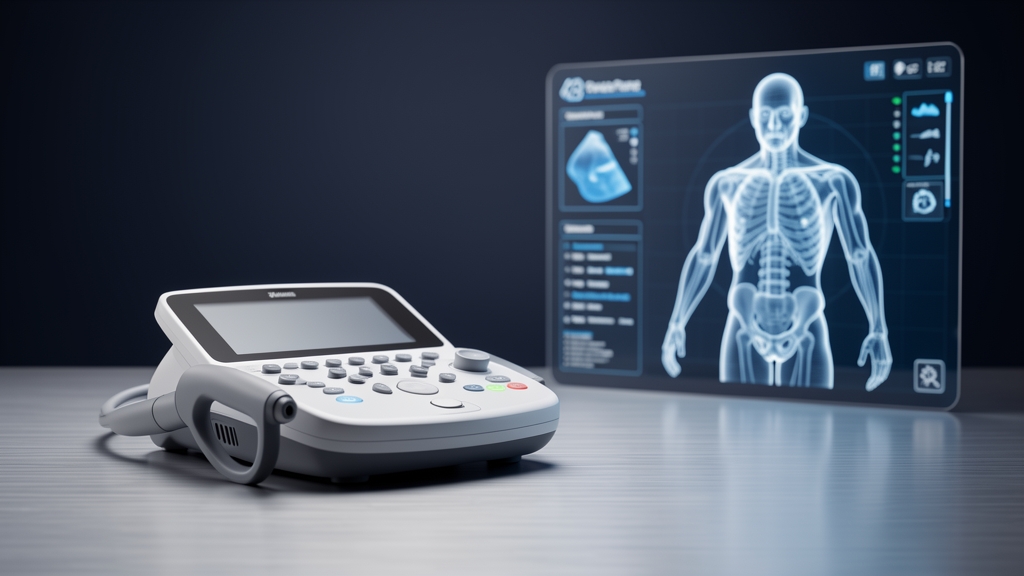
The Silicon vs. Synthesis War: Butterfly Network Reacts to Midjourney Medical’s Full-Body Ambition
The diagnostic imaging sector has long been defined by a slow, steady march of incremental improvements in transducer sensitivity and resolution. However, the announcement from Midjourney Medical regarding its "Full Body Ultrasound Scanner" has sent a seismic shock through the medical technology ecosystem, prompting an immediate and measured response from the industry’s most prominent semiconductor-based pioneer, Butterfly Network.
At the heart of this tension lies a fundamental disagreement over the future of medical diagnostics: Should we focus on perfecting the physical sensors that capture biological data, or should we focus on the generative algorithms that synthesize it?
The Midjourney Disruption: A Software-First Paradigm
Midjourney Medical’s announcement—though detailed technical specifications remain under wraps—suggests a move away from the traditional "probe-and-scan" method. The industry is buzzing with the possibility that Midjourney is leveraging advanced generative modeling to achieve what has long been considered impossible: a rapid, non-invasive, full-body volumetric scan using sparse sensor data.
If Midjourney’s technology works as rumored, it utilizes a "computational imaging" approach. Rather than requiring a technician to meticulously move a transducer over every square centimeter of a patient’s body, the system would use a limited number of high-fidelity sensor inputs and then use massive generative AI models to "fill in the blanks," reconstructing a complete, high-resolution 3D model of the human anatomy.
This represents a radical shift from "capturing" an image to "synthesizing" a medical reality.
The Butterfly Response: The Case for Hardware Fidelity
Butterfly Network, a company that has spent years democratizing ultrasound through its "Ultrasound-on-a-Chip" technology, was quick to provide commentary. While Butterfly’s statement remained diplomatic, the subtext was clear: hardware integrity is non-negotiable in clinical medicine.
Butterfly’s dominance is built on the semiconductor revolution. By replacing traditional piezoelectric crystals with silicon-based capacitive micromachined ultrasonic transducers (CMUTs), Butterfly has successfully shrunk a room-sized machine into a handheld device. Their approach is rooted in the physics of the signal—ensuring that the data captured at the source is accurate, scalable, and high-fidelity.
In its commentary, Butterfly emphasized the critical importance of "ground truth" data. For Butterfly, the goal is to provide clinicians with a perfect digital window into the body. The implication is that a system relying on generative reconstruction—essentially "predicting" what an organ looks like based on surrounding data—carries inherent risks that a hardware-centric approach does not.
The Technical Divide: CMUT vs. Generative Reconstruction
To understand the stakes, one must look at the underlying physics of these two competing philosophies.
The Semiconductor Approach (Butterfly): This relies on the miniaturization of transducers. By using silicon manufacturing processes, companies like Butterfly can mass-produce sophisticated sensors that capture real-time acoustic echoes. The intelligence lies in the software’s ability to process these real* signals, but the signal itself is a direct physical measurement of the patient’s anatomy.
* The Generative Approach (Midjourney Medical): This likely utilizes Diffusion Models or Transformer-based architectures trained on massive datasets of high-resolution CT and MRI scans. The scanner captures sparse acoustic "snapshots," and the AI performs a volumetric reconstruction, essentially hallucinating the missing anatomical structures with high statistical probability.
The "Hallucination" Problem in Clinical Settings
The most significant point of contention is the risk of "AI hallucinations." In the world of creative AI, a hallucination—where a model generates a detail that doesn't exist—is a charming quirk. In a clinical setting, a hallucination is a catastrophic diagnostic error.
If a generative scanner "predicts" a clear arterial wall where there is actually a subtle occlusion, or "smooths over" a small lesion because it doesn't fit the statistical model of a healthy organ, the consequences are life-threatening. This is the central argument that Butterfly and other hardware incumbents are expected to champion as they lobby regulatory bodies like the FDA.
Market Implications and the Path Forward
The collision of these two technologies will likely define the next decade of Point-of-Care Ultrasound (POCUS). We are seeing the emergence of two distinct market segments:
1. The High-Fidelity Diagnostic Tier: Driven by companies like Butterfly, focusing on surgeons, emergency physicians, and specialists who require absolute physical certainty.
2. The Rapid Screening Tier: Potentially led by Midjourney Medical, focusing on triage, remote health monitoring, and mass screening where speed and systemic overviews are prioritized over granular precision.
As the industry watches, the battleground will move from the laboratory to the regulatory halls. The question is no longer whether AI can image the human body, but whether we can trust the AI to tell us what it is seeing—or what it thinks it should be seeing.