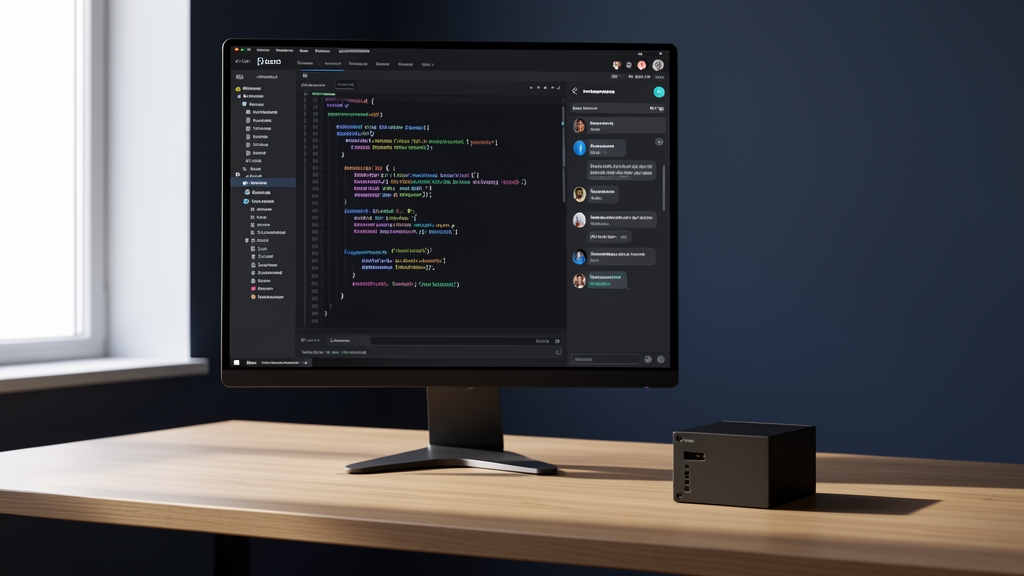
Bridging the Silicon Gap: How Axelera AI’s Voyager Wingman Aims to Solve the Edge AI Developer Crisis
In the relentless pursuit of artificial intelligence dominance, the industry has long focused on the "compute war"—a race to manufacture larger, faster, and more efficient silicon. However, as the frontier of AI shifts from massive cloud-based data centers to the "edge"—the localized sensors, drones, and smart devices that inhabit our physical world—a new, more subtle crisis is emerging. The hardware is ready, but the software is not.
The difficulty of deploying sophisticated neural networks onto specialized edge hardware is immense. Developers are often forced to navigate a labyrinth of low-level memory management, quantization protocols, and hardware-specific instruction sets. This friction creates a massive barrier to entry, where even the most powerful chip can become a paperweight if the software stack is too cumbersome to master.
Axelera AI, a prominent player in the edge AI chip sector, is attempting to dismantle this barrier. Today, the company officially released Voyager Wingman, an AI-driven development assistant designed to act as a bridge between high-level developer intent and low-level silicon execution.
The Developer Experience Problem
To understand the significance of Voyager Wingman, one must understand the "deployment tax" inherent in edge computing. Unlike cloud computing, where massive pools of VRAM and standardized architectures like NVIDIA’s CUDA make deployment relatively seamless, edge AI requires extreme optimization.
When a developer wants to run a vision model on an edge chip, they cannot simply "upload" the model. They must often perform:
* Quantization: Reducing the precision of model weights (e.g., from FP32 to INT8) to save power and memory.
* Pruning: Removing redundant neurons to decrease computational load.
* Hardware-Aware Mapping: Ensuring the model's layers align perfectly with the chip's specific Neural Processing Unit (NPU) architecture to minimize latency.
For most software engineers, this requires deep expertise in computer architecture and compiler theory—skills that are in short supply. Voyager Wingman aims to abstract this complexity away.
How Voyager Wingman Functions
Voyager Wingman is not a general-purpose chatbot. It is a specialized, domain-aware agent built specifically to interface with Axelera’s hardware ecosystem. By utilizing natural language processing, the tool allows developers to describe their goals—such as "optimize this transformer model for sub-10ms latency on the Axelera NPU"—and receive actionable code, configuration files, and troubleshooting advice.
The assistant operates across several critical development stages:
1. Code Generation and Translation: It can take high-level frameworks like PyTorch or TensorFlow and suggest the necessary transformations to make them compatible with Axelera’s specialized architecture.
2. Automated Troubleshooting: When a model fails to deploy due to memory overflows or unsupported operations, Wingman analyzes the error logs and suggests specific architectural tweaks to the model to resolve the conflict.
3. Optimization Guidance: Rather than just fixing errors, the tool acts as a consultant, suggesting where quantization might cause significant accuracy loss and where it can be applied aggressively to boost performance.
By integrating this LLM-driven layer into the development workflow, Axelera is essentially providing a "software-defined" entry point to their hardware.
Market Implications: The Full-Stack Strategy
Axelera’s move is a calculated strategic pivot. In the semiconductor industry, hardware is only as successful as its ecosystem. NVIDIA’s dominance is not merely a result of its GPU prowess; it is built on the bedrock of CUDA, a software layer that has become the industry standard. For a smaller, specialized player like Axelera to compete, it cannot just win on TOPS (Tera Operations Per Second); it must win on DX (Developer Experience).
By releasing Voyager Wingman, Axelera is signaling that it intends to be a full-stack provider. They are acknowledging that the winner of the edge AI race will not necessarily be the company with the most powerful chip, but the company that makes it easiest for a developer to go from a concept to a running device.
This move places Axelera in direct competition with the growing trend of "AI for AI" development tools. Companies like Hugging Face are simplifying model access, and NVIDIA is constantly refining its TensorRT optimization libraries. However, Axelera’s approach is uniquely vertically integrated—the assistant knows the silicon intimately because it was built for that specific silicon.
The Risks of Automated Optimization
While the promise of Voyager Wingman is immense, it is not without technical risks. The primary concern among systems engineers is the "black box" problem. If an LLM suggests a specific quantization strategy or a structural change to a neural network to satisfy hardware constraints, there is a risk that the developer may not fully grasp the implications for the model's accuracy or long-term stability.
In mission-critical edge applications—such as autonomous medical devices or industrial robotics—a slight degradation in model precision caused by an automated optimization "suggestion" could have catastrophic real-world consequences. The challenge for Axelera will be ensuring that Voyager Wingman provides not just solutions, but transparent, verifiable, and explainable optimizations.
The Path Ahead
The release of Voyager Wingman marks a turning point in how we approach specialized hardware. We are entering an era where the distinction between chip design and software engineering is blurring. As AI models become more complex and edge hardware becomes more specialized, the "middle layer"—the tools that translate human intent into machine execution—will become the most valuable part of the stack.
For Axelera, the success of Wingman will be the ultimate litmus test. If they can successfully reduce the time-to-deployment from weeks to hours, they may well secure their place as a cornerstone of the edge AI revolution.