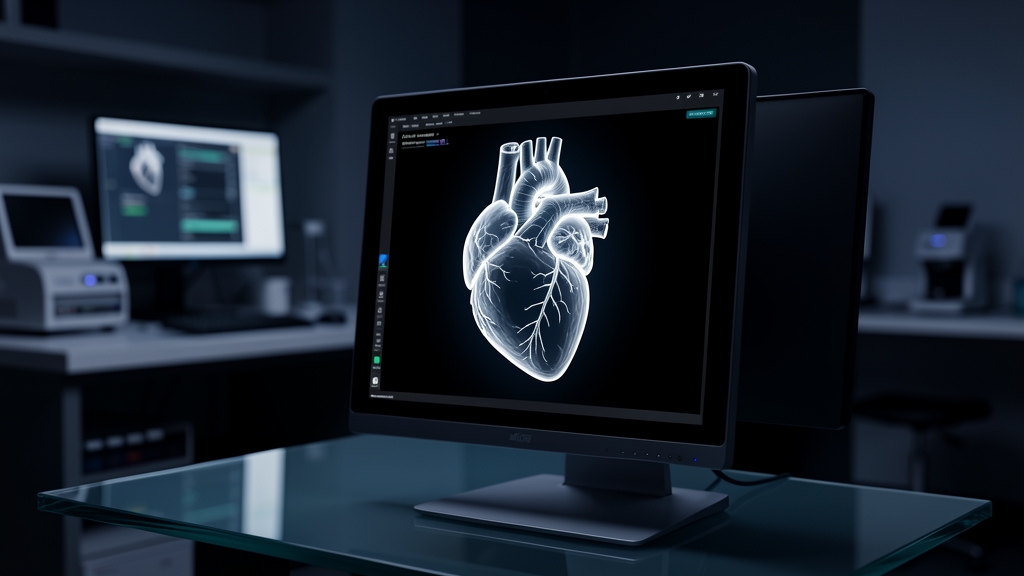
The transition from generating surrealist landscapes to interpreting human anatomy is a leap that few predicted, yet it is one that Midjourney is currently attempting to make. A recent video demonstration showcasing the company’s new medical imaging capabilities has ignited a fierce debate across the intersection of generative AI and healthcare. While the visuals are undeniably breathtaking, the tech industry is grappling with a fundamental question: In medicine, is "looking right" good enough?
For years, Midjourney has dominated the cultural zeit台 through its diffusion-based models, creating images that are indistinguishable from high-end photography. The new demonstration suggests that the company is applying these same latent space manipulation techniques to volumetric medical data—essentially treating MRI and CT scans as complex, multi-dimensional canvases.
The Visual Spectacle vs. Clinical Fidelity
The video in question shows a seamless, high-resolution traversal through a digitalized human torso. As the "scanner" moves, it reconstructs organs, vascular structures, and even subtle bone densities with a smoothness that feels more like a cinematic experience than a standard diagnostic tool. To the uninitiated, it looks like a revolution. To a radiologist, it looks like a masterpiece of interpolation.
The core of the controversy lies in the nature of diffusion models. At their heart, these models work by denoising data—turning chaos into structure based on probabilistic patterns. In the world of digital art, if a model adds a stray leaf to a forest or a slightly different shadow to a face, the result is still a "good" image. In medical diagnostics, however, the difference between a noise artifact and a micro-calcification is the difference between a correct diagnosis and a fatal error.
"The danger of generative models in medicine is the 'hallucination' problem," says one prominent researcher in medical AI. "A diffusion model is designed to create the most probable version of an image. But medicine is often found in the improbable—the anomaly, the tiny irregularity that doesn't fit the standard pattern. If the AI 'smooths out' a tumor because it looks like noise, the technology fails its primary purpose."
The Synthetic Data Frontier
Despite the skepticism, the potential applications for Midjourney’s underlying architecture are profound, particularly in the realm of synthetic data generation. One of the greatest bottlenecks in medical AI development is the scarcity of high-quality, annotated datasets, especially for rare pathologies.
If Midjourney can master the ability to generate anatomically accurate, "ground truth" synthetic scans, it could provide the training fuel for a whole new generation of diagnostic tools. By generating millions of variations of a specific rare condition, researchers can train other AI models to recognize those conditions with unprecedented accuracy, without ever compromising patient privacy.
This is where the market impact becomes clear. If Midjourney moves beyond being a creative tool and becomes a data provider, it enters a multi-billion dollar arena currently occupied by giants like NVIDIA and Siemens Healthineers. The ability to simulate biological complexity within a latent space could drastically accelerate drug discovery and surgical planning.
The Regulatory and Ethical Wall
However, the path from a viral video to a clinical setting is paved with regulatory hurdles that a generative art company is arguably unprepared for. The FDA and other global health authorities require more than just impressive demonstrations; they require rigorous, peer-reviewed evidence of "interpretability" and "reproducibility."
Current generative models are notoriously "black boxes." Even the developers cannot always explain why a model chose a specific pixel configuration. In a clinical environment, "because the model thought it looked right" is an unacceptable justification for a surgical decision. For Midjourney to succeed, they must move toward "physics-informed" neural networks—models that are constrained by the actual laws of human biology and the physics of imaging, rather than just the statistical likelihood of pixel placement.
Furthermore, there is the looming question of bias. If the training data used to create these medical models lacks diversity in terms of age, gender, or ethnicity, the "scans" produced will reflect those gaps, potentially leading to systemic diagnostic errors in marginalized populations.
A Pivot or a Perilous Detour?
As it stands, Midjourney’s medical demonstration is a provocative signal of where generative AI is headed. It highlights a shift in the company's identity from a niche creative engine to a fundamental player in high-stakes data reconstruction.
The industry is currently watching to see if Midjourney will release technical white papers or seek clinical partnerships. Until then, the "medical scanner" remains a brilliant, albeit unproven, glimpse into a future where the line between digital synthesis and biological reality becomes increasingly blurred. The question is no longer whether AI can see inside the human body, but whether we can trust what it tells us it sees.