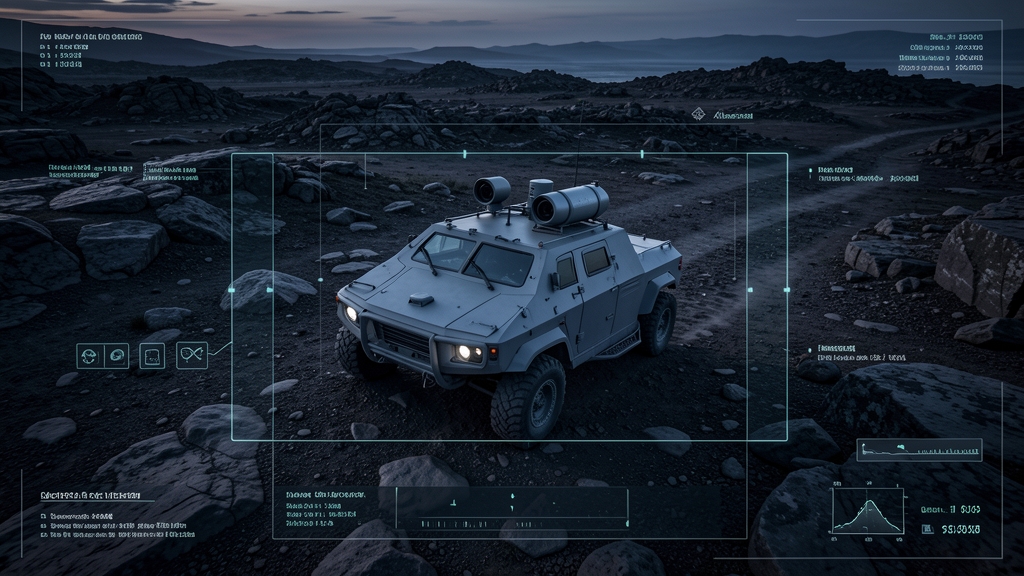
The paradigm of autonomous warfare is shifting. It is no longer enough for a machine to simply move from point A to point B; in the modern tactical landscape, a machine must perceive, decide, and defend. First Hydrogen Corp. (TSXV: FHYD) is positioning itself at the center of this evolution, announcing a strategic advancement in the development of artificial intelligence capabilities for its autonomous Unmanned Ground Vehicle (UGV) platform.
This move represents a critical pivot for the company. While First Hydrogen has built its reputation on the energy density and endurance of hydrogen fuel cell technology, the integration of high-level AI marks a transition from a hardware-centric energy provider to a sophisticated systems integrator. The goal is clear: to create a UGV that possesses both the "stamina" of hydrogen power and the "intellect" of modern machine learning.
The Convergence of Endurance and Intelligence
The primary limitation of current autonomous robotic systems is often the "autonomy-endurance trade-off." Battery-electric UGVs are frequently tethered to short mission profiles, as the weight of the batteries required for long-range operations significantly degrades their payload capacity and mobility. Hydrogen fuel cells solve the endurance problem, offering high energy density that allows for extended patrols and long-duration missions.
However, endurance without intelligence is merely a mobile target. By layering AI-enabled capabilities onto a hydrogen-powered chassis, First Hydrogen is attempting to solve the dual challenge of the modern battlefield: how to keep a robot in the field for days at a time while ensuring it can navigate complex, contested environments without constant human intervention.
The Counter-Drone Mandate
Perhaps the most significant aspect of this announcement is the focus on counter-drone capabilities. Recent global conflicts have demonstrated that small, low-cost Unmanned Aerial Vehicles (UAVs) can pose an existential threat to traditional ground assets. The proliferation of "kamikaze" drones and aerial surveillance has forced a rethink of ground-based security.
First Hydrogen’s AI integration aims to address this by equipping UGVs with the ability to:
* Detect and Identify: Utilizing computer vision and multi-spectral sensors to distinguish between birds, civilian aircraft, and hostile drones in real-time.
* Autonomous Tracking: Maintaining a lock on fast-moving aerial targets to facilitate localized defense measures.
* Threat Assessment: Using machine learning algorithms to categorize the intent and danger level of detected objects, allowing the UGV to prioritize responses.
This transforms the UGV from a simple logistics or reconnaissance tool into a mobile, autonomous defense node. A fleet of these vehicles could potentially create a "denial zone," providing a layered defense against aerial incursions in environments where human operators are at high risk.
Technical Challenges: The Edge Computing Hurdle
Integrating heavy-duty AI into a mobile platform is not without significant technical friction. The "intelligence" must reside at the "edge"—meaning the processing must happen on the vehicle itself rather than in a remote cloud server. This is vital for low-latency decision-making in combat or high-stakes security scenarios.
The challenge for First Hydrogen lies in balancing the computational power required for advanced neural networks with the power constraints of the vehicle. While hydrogen fuel cells provide more energy than lithium-ion batteries, the sudden, high-current draws required by intensive AI processing and sensor arrays (such as LiDAR, thermal imaging, and high-resolution optical cameras) require sophisticated power management systems.
Furthermore, the software stack must be ruggedized. AI trained in a lab environment often struggles with the "noise" of the real world—dust, rain, extreme temperature fluctuations, and electronic warfare environments designed to jam signals.
Market Implications and the Dual-Use Path
The announcement comes at a time when defense spending globally is pivoting toward "attritable" autonomous systems—platforms that are sophisticated enough to be effective but inexpensive enough to be lost in combat without catastrophic strategic loss.
By focusing on AI-enabled UGVs, First Hydrogen is tapping into a massive dual-use market. While the immediate focus is clearly defense, the underlying technology—long-range autonomous navigation and object recognition—has profound implications for industrial sectors. Automated mining, large-scale agricultural monitoring, and hazardous material transport all require the same marriage of long-duration power and intelligent perception.
As First Hydrogen continues to develop these capabilities, the industry will be watching closely to see if they can successfully bridge the gap between energy technology and high-level robotics. If successful, they will not just be providing the fuel for the machines of the future, but the very brains that drive them.