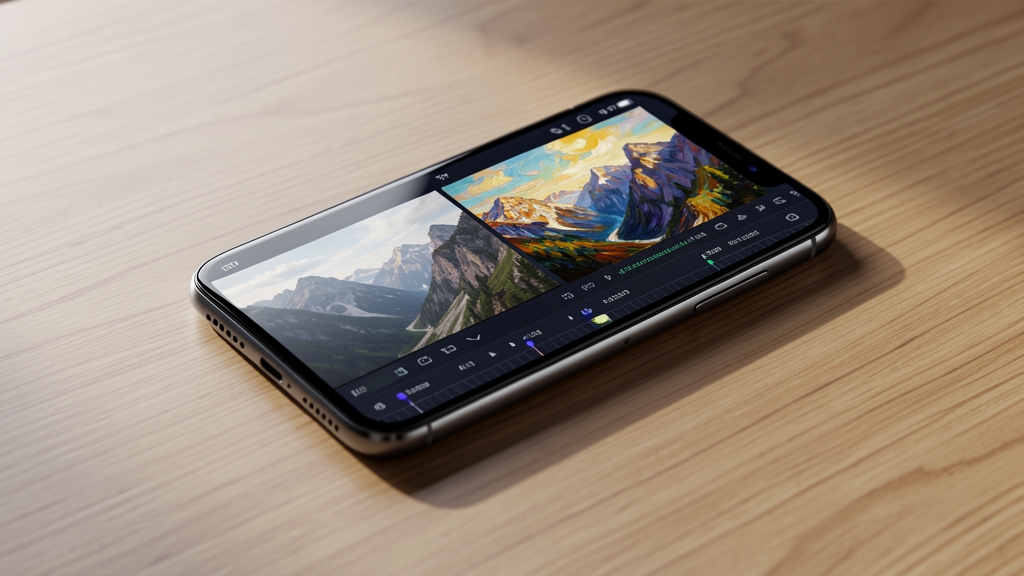
For more than a decade, Google Photos has functioned primarily as a sophisticated digital warehouse. Its value proposition was built on the pillars of storage, organization, and retrieval—the ability to find that one specific clip of a birthday party from three years ago using nothing but a search query. But today, the paradigm shifts. Google is no longer content with merely helping you find your memories; it wants to help you reinvent them.
The announcement of "Video Remix" marks a pivotal evolution for the Google Photos ecosystem. This isn't a simple suite of aesthetic filters or color grading presets. Instead, it is a deep integration of generative AI designed to manipulate the very fabric of video data. Users can now apply stylistic transformations to entire clips, swap out mundane backgrounds for cinematic landscapes, and adjust the atmospheric lighting of a scene, all through an intuitive mobile interface.
The Mechanics of Motion: Beyond Static AI
To understand the technical gravity of this update, one must differentiate between the generative AI we see in static image tools and the complexities of video. In a still photograph, an AI model only needs to ensure spatial consistency—making sure the lighting on a face matches the new background. In video, the model must manage temporal consistency.
The "Video Remix" engine addresses the "flicker problem" that has long plagued AI-generated video. When an AI attempts to restyle a video, it processes frames individually. Without sophisticated temporal modeling, the result is a jittery, hallucinatory mess where the texture of a sweater or the position of a shadow shifts erratically from one millisecond to the next.
Reports suggest that Google is leveraging its latest advancements in latent diffusion models—technologies similar to those powering its most advanced generative video research—to ensure that changes remain stable across the entire duration of a clip. By analyzing motion vectors and semantic segmentation, the app can "lock onto" a subject, such as a person or a pet, and apply transformations to the environment around them without distorting the subject’s identity or movement.
Feature Breakdown: A New Creative Workflow
The Video Remix feature appears to be structured around three core pillars of manipulation:
* Stylistic Overhauls: Users can prompt the app to transform a standard smartphone video into something else entirely—a hand-drawn animation, a claymation sequence, or a high-contrast noir film. This goes beyond color LUTs (Look-Up Tables); it changes the structural rendering of objects within the frame.
* Semantic Background Replacement: This is perhaps the most ambitious component. Using advanced depth-mapping, the app can isolate the foreground subject and replace the background with entirely new, AI-generated scenery. A video taken in a crowded living room can, with a few taps, be reimagined as a serene walk through a redwood forest.
* Atmospheric Re-lighting: The feature allows for the adjustment of the "mood" of a video by simulating different light sources. Users can introduce golden hour warmth to a midday clip or add dramatic shadows to a flatly lit scene, significantly raising the production value of amateur footage.
The Market Impact: The War for the Creator Economy
This move places Google in direct competition with the social giants—TikTok, Instagram, and Snapchat—that have long dominated the short-form video editing space. While those platforms offer powerful "effects" and "filters," they are largely built for immediate, ephemeral consumption. Google is positioning Video Remix as a tool for meaningful content—the videos that live in your library forever.
By integrating these tools into a platform where users already store their life's history, Google is lowering the barrier to entry for high-end video production. The democratization of "cinematic" editing means that the gap between a professional editor and a casual parent recording a toddler’s first steps is shrinking.
Furthermore, this represents a strategic move to solidify Google's AI dominance. As mobile hardware becomes increasingly capable of running large-scale models locally, Google is signaling that its cloud-integrated ecosystem is the most seamless way to experience the cutting edge of generative media.
The Ethical Frontier: Authenticity in the Age of Remix
However, the ability to reconstruct reality brings significant philosophical and ethical baggage. If a user can change the background of a video or alter the lighting to make a scene appear more dramatic, at what point does a "memory" stop being a record of truth and start becoming a piece of fiction?
As generative AI becomes more proficient at "fixing" or "improving" our lives, the industry faces a growing tension between aesthetic perfection and historical accuracy. Google has yet to detail how it will watermark or label "remixed" content, a crucial step in preventing the unintentional spread of manipulated media that could be mistaken for reality.
For the tech enthusiast, the arrival of Video Remix is a breathtaking glimpse into the future of personal media. We are moving away from the era of "capture and store" and entering the era of "capture and compose." The question is no longer just "what happened?" but "how do you want to remember it?"