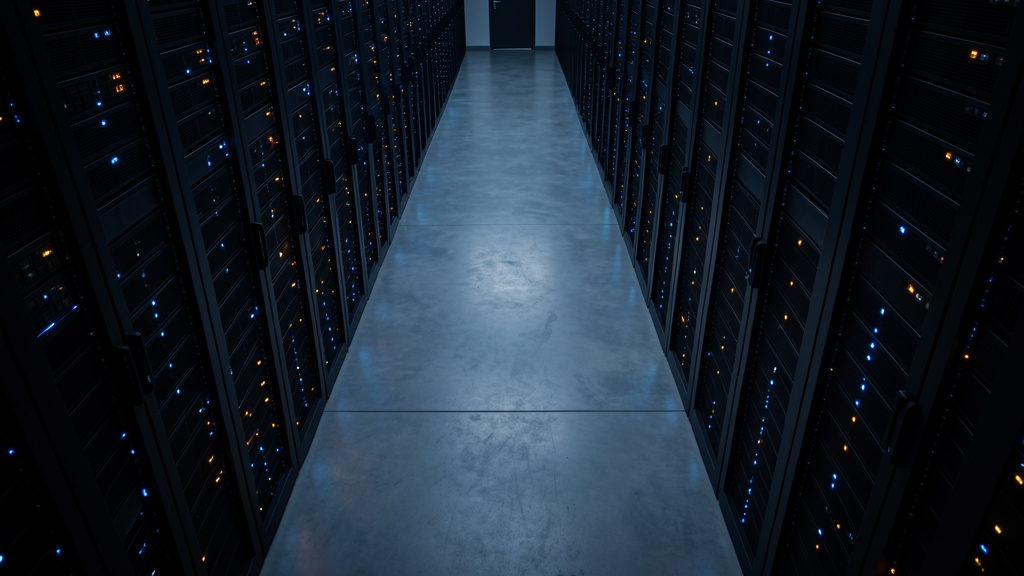
The era of limitless digital expansion is hitting a physical limit.
In a move that has sent shockwaves through Silicon Valley, Google has reportedly declined Meta’s request for expanded access to its Gemini AI suite. While industry analysts initially viewed the standoff as a standard competitive maneuver between two titans, the reality is far more clinical and much more concerning. The refusal isn't based on intellectual property disputes or market strategy; it is a direct consequence of a critical compute shortage.
Google is effectively rationing its most valuable resource: the massive, interconnected clusters of specialized silicon required to run, fine-tune, and serve its most advanced reasoning models. This decision marks a pivot point for the entire artificial intelligence industry, moving the battleground from "who has the best algorithms" to "who owns the most electrons and silicon."
The Calculus of Scarcity
For the past several years, the AI narrative has been dominated by the pursuit of scale. The logic was simple: more data, more parameters, more compute, more intelligence. However, we are witnessing the mathematical exhaustion of that logic. The computational requirements for next-generation frontier models are scaling at a rate that is outpacing the manufacturing and deployment capabilities of the global semiconductor supply chain.
When Google tells Meta "no," it is acknowledging a fundamental truth that many startups prefer to ignore: compute is a finite, physical commodity. Unlike software, which can be replicated infinitely at near-zero marginal cost, high-end AI inference and training require massive, tangible infrastructure.
This "compute crunch" is driven by three primary bottlenecks:
* Silicon Throughput: Even with the rapid deployment of new Blackwell-class architectures and custom TPUs, the sheer volume of chips required to support global demand for LLMs (Large Language Models) is creating a massive lead-time gap.
* The Power Grid Constraint: Data centers are no longer just buildings; they are voracious consumers of energy. The ability to scale AI is now inextricably linked to the ability to secure massive, reliable, and increasingly expensive electrical loads.
* Thermal and Spatial Limits: The physical density of high-performance compute clusters is reaching the limits of traditional air and liquid cooling technologies, making the expansion of data centers a complex engineering hurdle rather than a simple real estate play.
The Great Stratification
The Google-Meta standoff highlights a widening chasm in the AI ecosystem. We are entering an era of "Compute Stratification," where the industry is splitting into two distinct classes.
On one side are the "Sovereign AI" players—companies like Google, Microsoft, and Meta themselves—who possess the capital to build their own proprietary hardware pipelines and massive energy-dense campuses. These entities are not just building models; they are building the ecosystems that host them.
On the other side are the "Tenant AI" players—the thousands of startups, research labs, and enterprises that rely on API access to the giants' models. For these players, the risk is no longer just being out-innovated; it is being de-prioritized. If a provider like Google decides to limit access to preserve its own latency or training cycles, the entire downstream economy of AI applications could face sudden, arbitrary contraction.
The Shift from Software to Infrastructure
Historically, the tech industry has been defined by the "software is eating the world" mantra. Software provides the leverage to scale without friction. AI, however, is behaving more like heavy industry. It is capital-intensive, resource-dependent, and physically constrained.
This shift changes the competitive landscape entirely. In the previous decade, a brilliant team of researchers with a revolutionary architecture could disrupt an incumbent. In the current landscape, that same team faces a wall. They may have the best code in the world, but if they cannot secure a reservation on a high-performance cluster, their code remains academic curiosity.
We are seeing the emergence of a new kind of moat. It is no longer enough to have a proprietary dataset or a clever attention mechanism. To survive the next wave of AI development, a company must demonstrate "infrastructure sovereignty." This means vertical integration: owning the chips, the cooling, the power, and the data centers.
The Looming Macroeconomic Impact
The implications of this capacity crunch extend far beyond the walls of Silicon Valley. As compute becomes the most sought-after commodity on earth, we are likely to see a massive reallocation of global capital. We are seeing investments move away from pure-play software and toward energy infrastructure, semiconductor fabrication, and advanced materials science.
Furthermore, the geopolitical dimension cannot be overstated. The struggle for compute is, at its core, a struggle for the hardware that will underpin the next century of economic productivity. The Google-Meta incident is a canary in the coal mine, signaling that the "scaling laws" that have fueled the AI boom are about to run head-first into the reality of physical constraints.
The industry is no longer just competing to see who can build the smartest machine. They are competing to see who can keep the lights on long enough to build it.