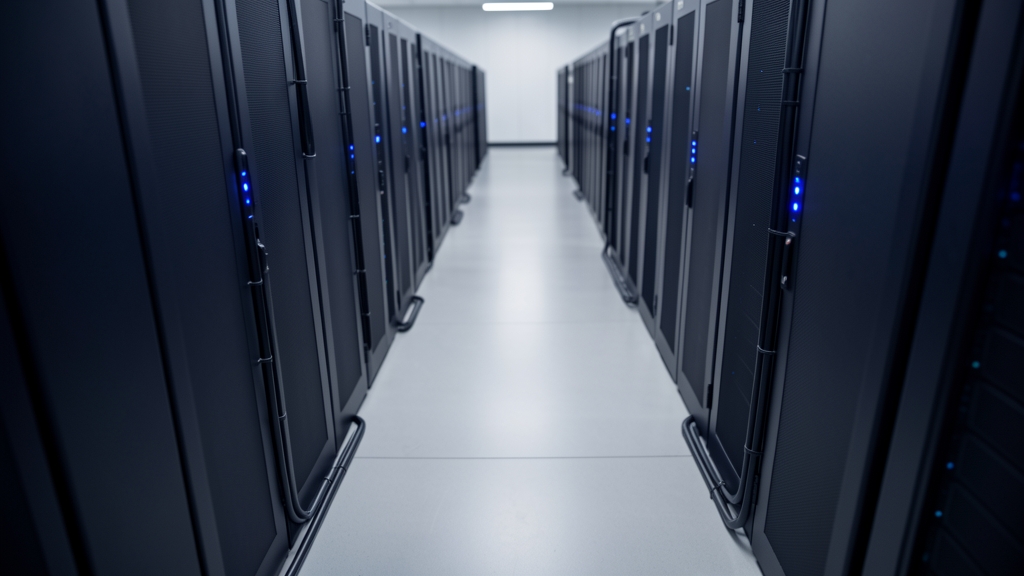
The movement in the equity markets today tells a clear story: the AI revolution is moving from the software layer into the physical realm. As news broke of South Korea’s unprecedented \$1 trillion investment plan aimed at dominating the semiconductor and AI data center sectors, Vertiv (VRT) saw its stock price surge, signaling intense investor confidence in the companies that build the "nervous system" of the digital age.
While headlines often gravitate toward the massive LLM (Large Language Model) providers or the high-profile chip designers, the real bottleneck in the AI race is increasingly becoming physical. We are witnessing a shift from a world of general-purpose computing to a world of hyper-dense, high-thermal-output AI compute. This transition requires a complete overhaul of how data centers are powered and cooled—a niche where Vertiv has established a formidable moat.
The South Korean Catalyst
The sheer scale of the South Korean announcement cannot be overstated. By committing \$1 trillion to a coordinated push in semiconductor manufacturing and AI-specialized data center infrastructure, Seoul is effectively attempting to corner the market on the hardware required to run the next decade of intelligence.
South Korea is already a cornerstone of the global supply chain, home to giants that produce the High Bandwidth Memory (HBM) essential for modern AI accelerators. This new investment ensures that the ecosystem surrounding these components—the manufacturing facilities, the testing labs, and the massive data centers that will process this data—will be built at a scale never before seen. For infrastructure providers, this represents a multi-decade pipeline of capital expenditure.
The Thermal Crisis: Why Liquid Cooling is No Longer Optional
To understand why Vertiv is the primary beneficiary of this news, one must understand the physics of an AI cluster.
Traditional data centers were designed for "standard" workloads—web hosting, email, and database management. These workloads are relatively low-density and can be cooled using large, energy-intensive air conditioning units that blow cold air through server racks. However, an AI-optimized rack, packed with high-performance GPUs, operates under fundamentally different thermal constraints.
As chip manufacturers push more transistors into smaller spaces to increase compute density, the heat generated per square inch has skyrocketed. We are approaching a thermal limit where air cooling is simply no longer physically capable of removing heat fast enough to prevent hardware failure or thermal throttling.
This is the "Liquid Cooling Transition." Technologies such as Direct-to-Chip (DTC) cooling and immersion cooling are moving from experimental niches to industrial requirements. Vertiv’s expertise in liquid-to-liquid heat exchangers, cooling distribution units (CDUs), and sophisticated thermal management systems places them at the exact point where the industry’s greatest problem meets its greatest demand.
Power Density and the Grid Challenge
Beyond heat, there is the issue of power. An AI data center consumes significantly more electricity per rack than a traditional facility. This necessitates a more complex power architecture, including:
* Uninterruptible Power Supplies (UPS): To manage the massive, sudden surges in power demand.
* Power Distribution Units (PDUs): To deliver stable, high-voltage electricity directly to the chips.
* Microgrid Integration: Managing the interaction between the data center and the local electrical grid to ensure stability.
As South Korea builds out its specialized AI zones, the complexity of the electrical infrastructure required to keep these clusters running will scale alongside the compute power. Vertiv’s integrated approach—combining power management with thermal management—makes them a one-stop shop for the massive, complex builds that these new government-backed projects will require.
The "Pick and Shovel" Thesis
In every major resource rush, the most consistent winners are often not the miners, but the providers of the picks and shovels. In the current AI era, the "gold" is intelligence, the "miners" are the LLM developers, and the "shovels" are the power and cooling components.
The South Korean investment acts as a massive multiplier for this thesis. It is not merely an investment in chips; it is an investment in a complete, end-to-end industrial ecosystem. As this ecosystem scales, the demand for high-reliability, high-density infrastructure components becomes a non-negotiable requirement rather than an optional upgrade.
Investors are clearly reading the writing on the wall. The surge in Vertiv's valuation reflects a recognition that while the software side of AI may face volatility and shifting consumer trends, the physical necessity of cooling and powering the machines remains an absolute constant.