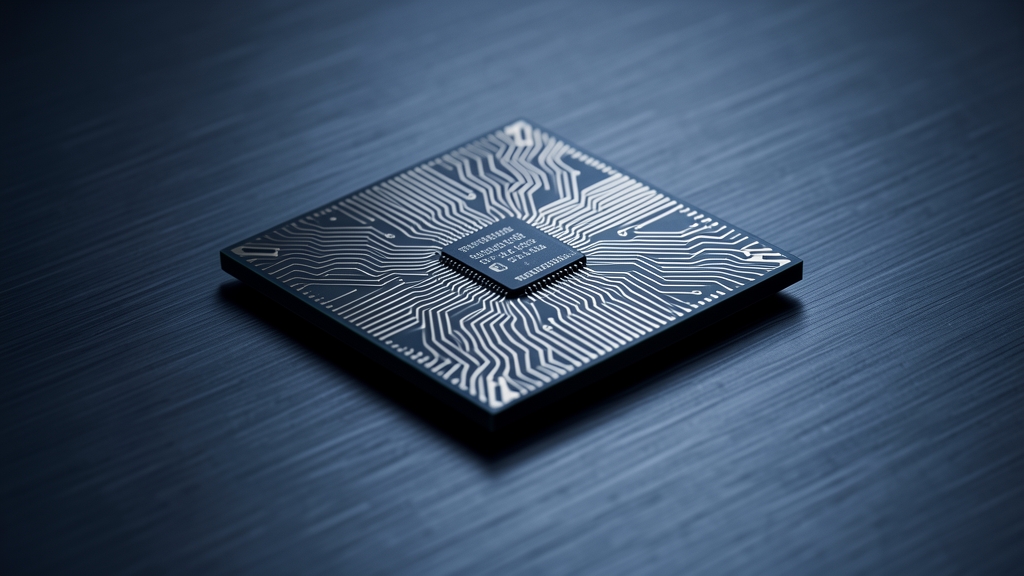
Silicon Sovereignty: Why Meta’s New In-House AI Chip is a Direct Challenge to the Status Quo
The era of the "software-only" social media giant is officially over. For years, Meta has been defined by its ability to capture attention through massive user bases and sophisticated algorithms. But as the industry shifts from the attention economy to the intelligence economy, Mark Zuckerberg is making it clear: to control the future of AI, Meta must control the silicon that powers it.
Internal reports and industry intelligence suggest that Meta is moving into the final stages of a massive strategic pivot. The company is set to begin production of its newest, most advanced in-house AI chip this September. This is not merely an incremental hardware update; it is a declaration of independence from the current semiconductor hegemony.
Breaking the Compute Tax
For the past few years, the industry has been defined by a single, inescapable reality: the "NVIDIA tax." As every major tech player scrambled to build large language models (LLMs), they found themselves at the mercy of a limited supply of high-end GPUs. This scarcity drove prices to astronomical levels, forcing companies to spend tens of billions of dollars on hardware that—while powerful—is designed for general-purpose computing rather than the specific, hyper-optimized workloads of a single company's AI stack.
Meta’s decision to enter production in September signals an aggressive attempt to mitigate this dependency. By designing custom silicon, Meta can optimize every transistor for its specific architectural needs, particularly for the Llama family of models.
The goal is twofold: efficiency and cost. While general-purpose GPUs are incredible tools, they carry significant overhead. A custom chip can strip away the unnecessary components required for broader graphics or varied computational tasks, focusing entirely on the high-speed matrix multiplications and massive memory bandwidth required for AI inference and training.
The Inference Bottleneck
A critical technical detail emerging from this move is the likely focus on inference. While much of the industry's recent attention has been on the massive compute required to train models, the real, long-term cost of AI lies in inference—the process of actually running those models for billions of users in real-time.
As Meta integrates AI into every facet of its ecosystem—from Instagram Reels and WhatsApp to its burgeoning augmented reality (AR) glasses—the demand for inference is scaling exponentially. Running a massive LLM on a generic GPU for every user query is financially unsustainable at the scale Meta operates.
The upcoming September production run likely targets this exact bottleneck. A chip specifically tuned for the Llama architecture could offer a much higher "performance-per-watt" ratio, allowing Meta to deploy more intelligent features across its platforms without a corresponding explosion in operational expenditure (OpEx).
Vertical Integration: The Apple Playbook
This move places Meta in an elite group of vertically integrated tech titans. By controlling the software (Llama), the operating systems (Ray-Ban Meta/Quest), and now the silicon, Meta is following the blueprint laid out by Apple.
When a company owns the entire stack, the synergy is profound:
* Hardware-Software Co-design: Engineers can design the chip architecture to match the mathematical operations of the software, and vice-versa.
* Latency Reduction: Custom silicon allows for tighter integration with proprietary interconnects, reducing the time it takes for data to travel between chips.
* Energy Efficiency: In the massive data centers that Meta operates, power consumption is the ultimate ceiling. Custom chips allow for much more granular control over thermal and power management.
This strategy creates a formidable "moat." While competitors can download Meta's open-source models, they cannot easily replicate the hardware-level efficiency that Meta is building to run those models.
Market Implications and the Path Ahead
The timing of the September production date is no coincidence. As the market looks for signs that the massive capital expenditure (CapEx) seen in the AI sector will translate into actual profitability, Meta is showing its hand. Moving from a position of pure buyer to a position of manufacturer is a signal to investors that the company is focused on long-term margin expansion.
However, the transition will not be without risk. Designing high-end silicon is one of the most difficult engineering feats in existence. Meta must compete with the sheer engineering might of NVIDIA, AMD, and the custom silicon divisions of Google and Amazon. Any delay in production or failure to meet performance benchmarks could result in massive wasted capital.
Regardless of the outcome, the move marks a fundamental shift in Meta's identity. The company is no longer just building the digital town square; it is building the engine that makes the town square smart. As production begins this September, the industry will be watching closely to see if Meta's silicon bet pays off, or if the cost of independence is simply too high.