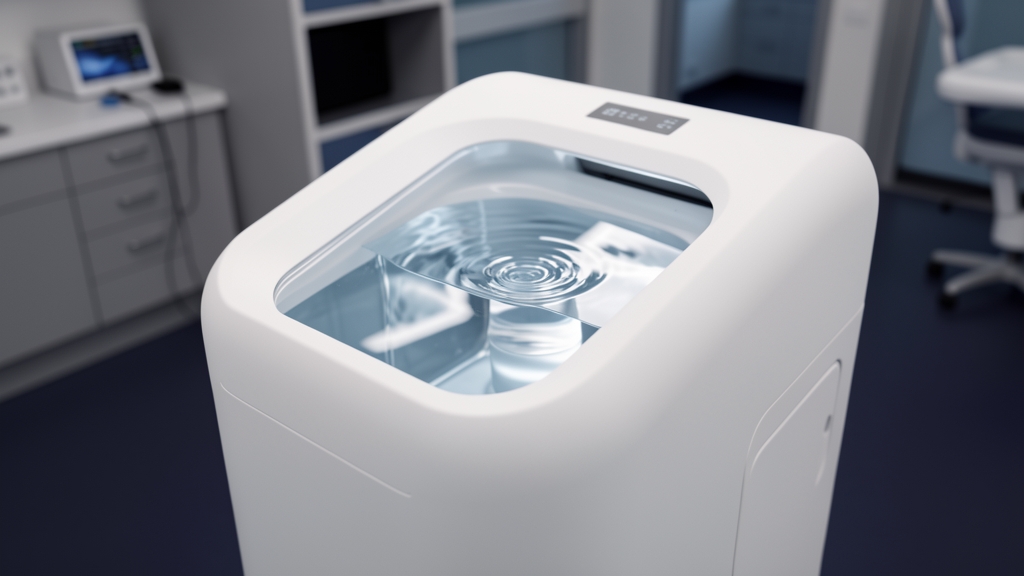
Beyond the Canvas: Midjourney Medical Unveils Rapid Full-Body Acoustic Imaging System
For years, the name Midjourney has been synonymous with the ethereal, the surreal, and the hyper-aesthetic. The company’s mastery over the latent space—the mathematical realm where pixels find meaning—has redefined digital creativity. But in a move that has sent shockwaves through both the Silicon Valley tech scene and the global medical community, Midjourney is stepping out of the gallery and into the clinic.
The announcement of "Midjourney Medical" marks one of the most ambitious pivots in the history of artificial intelligence. The company is not merely releasing a software tool for doctors; it is introducing a proprietary full-body imaging system designed to capture high-fidelity anatomical data in a staggering 60 seconds.
The Physics of Sight: Sound, Water, and Silicon
The technical architecture behind this breakthrough is as unconventional as its origin. Unlike traditional MRI (Magnetic Resonance Imaging) or CT (Computed Tomography) scans, which rely on massive magnets or ionizing radiation, the Midjourney Medical system utilizes a hybrid approach of acoustic waves and fluid dynamics.
At the core of the system is a specialized immersion medium—a controlled water-based environment that acts as a perfect conductor for sound waves. By utilizing water, the system eliminates the air-gap interference that often plagues standard ultrasound, allowing for deeper and more consistent wave penetration across the entire human form.
The hardware backbone of this system is powered by technology from Butterfly Network. By incorporating Butterfly’s industry-leading ultrasound-on-a-chip architecture, Midjourney has managed to miniaturize the complex sensors required for high-resolution imaging. However, the true "magic" happens in the software layer. Midjourney is applying its deep learning expertise in image synthesis to a new domain: Acoustic-to-Visual Transduction.
Rather than simply displaying raw ultrasound echoes, the Midjourney Medical engine interprets the returning sound waves through a generative model. It reconstructs the human anatomy in real-time, translating acoustic signals into high-definition 3D volumetric renders that rival the clarity of much more expensive, stationary imaging machines.
The 60-Second Paradigm Shift
The primary value proposition is speed. In current clinical settings, a full-body scan is a logistical marathon involving patient preparation, positioning, and lengthy acquisition times that can take anywhere from twenty minutes to an hour.
The Midjourney system aims to compress this entire process into a single minute. This is made possible by "Parallel Waveform Sampling." Instead of scanning the body in a linear, point-by-point fashion, the system uses the water medium to flood the body with multi-directional acoustic signals simultaneously. The AI then performs a massive, simultaneous reconstruction of all captured data points.
This speed has profound implications for several key sectors:
* Emergency Medicine: In trauma scenarios where "the golden hour" determines survival, the ability to instantly visualize internal bleeding or organ damage could be life-saving.
* Point-of-Care Diagnostics: The system’s reliance on ultrasound-on-a-chip technology suggests a level of portability that could bring high-end imaging to rural clinics, ambulances, and even remote field hospitals.
* Preventative Screening: Rapid, non-invasive, and radiation-free scanning could encourage more frequent wellness checks, catching pathologies long before they reach critical stages.
The "Generative Risk": A Journalistic Inquiry
However, the entry of a generative AI powerhouse into the medical field is not without intense scrutiny. The very strength of Midjourney—its ability to "fill in the gaps" to create a coherent image—is its greatest potential liability in a diagnostic context.
In the world of digital art, a "hallucination"—where the AI adds a detail that wasn't in the prompt—is a feature of creativity. In medicine, a hallucination is a catastrophe. If the Midjourney Medical engine encounters an area of low-signal data, there is a theoretical risk that its generative model might "smooth over" a small tumor or an irregular lesion, interpreting it as healthy tissue based on its training data.
"We are looking at a fundamental shift in how we define medical evidence," says one industry analyst. "We are moving from 'capturing a signal' to 'synthesizing a representation.' The question is whether the representation is an accurate reflection of reality, or merely a statistically probable version of it."
To combat this, Midjourney Medical claims to have implemented a "Fidelity Guardrail" system. This secondary neural network is tasked specifically with identifying areas of high uncertainty in the reconstruction and flagging them for human review, ensuring that the AI never "guesses" where a clinician needs certainty.
Market Implications and the Road Ahead
The competitive landscape is already reacting. Traditional imaging giants, who have spent decades perfecting hardware-heavy solutions, now face a software-first competitor that treats anatomy as a complex data reconstruction problem.
As Midjourney Medical moves toward clinical trials and regulatory approval, the tech world is watching closely. This is more than a product launch; it is a test case for the ultimate application of generative AI. If Midjourney can prove that its ability to navigate the latent space of art can be safely applied to the biological reality of the human body, the boundary between digital intelligence and physical healthcare may disappear entirely.
The era of the "generative doctor" may be closer than anyone anticipated.