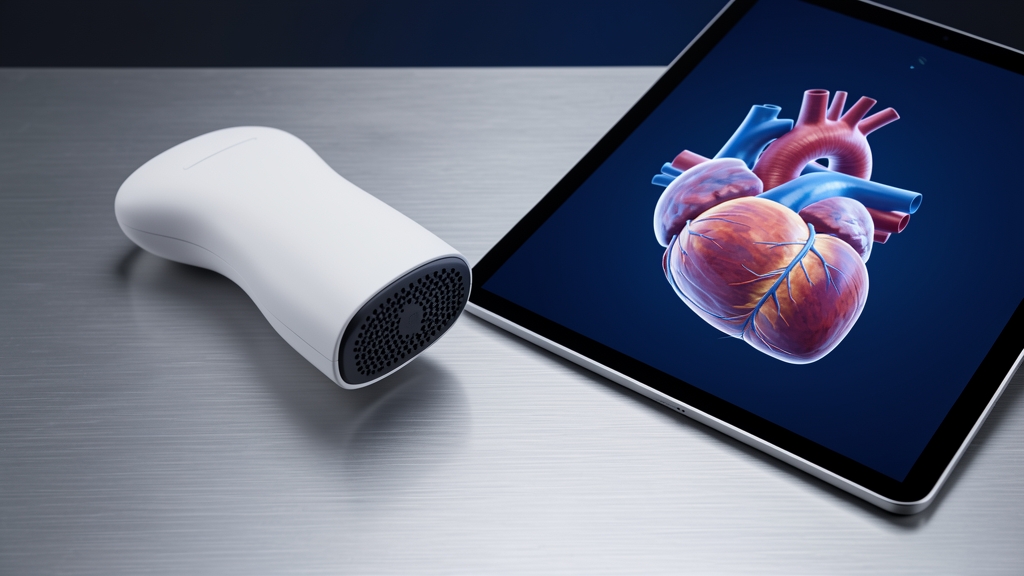
The boundaries between digital art and clinical reality just blurred. Midjourney, the company that redefined the landscape of generative artificial intelligence through high-fidelity image synthesis, has officially pivoted into the hardware space. With the announcement of "Midjourney Medical," the company is moving beyond the prompt box and into the doctor's office, debuting its flagship device: the Midjourney Scanner.
The announcement, made this morning, marks one of the most radical strategic shifts in the history of the AI industry. For years, Midjourney has been synonymous with "creative hallucination"—the ability of an AI to dream up breathtakingly realistic imagery from mere text. Now, the company is betting that the same underlying principles of generative reconstruction can be harnessed to visualize the human body with unprecedented clarity.
The Anatomy of the Scanner: A Transducer Revolution
At the heart of the Midjourney Scanner lies a radical departure from traditional ultrasound and imaging hardware. While conventional medical imaging relies on large, singular piezoelectric crystals to send and receive waves, the Midjourney Scanner utilizes a dense, microscopic architecture.
The device is composed of thousands of miniature components known as transducers. These tiny sensors act as a high-density grid, capturing mechanical wave data at a resolution that traditional probes struggle to match. Instead of capturing a single, broad "snapshot" of tissue, the array collects a massive cloud of raw acoustic and thermal data points.
This is where the Midjourney software engine takes over. Unlike standard medical imaging software, which focuses on signal processing and noise reduction, Midjourney’s proprietary medical engine uses generative latent space modeling. It treats the raw, noisy data from the transducer array as a "prompt," reconstructing a high-fidelity, three-dimensional volumetric map of the biological structures being scanned.
"The goal isn't just to capture a picture of the liver or a heart," says a technical analyst closely following the announcement. "The goal is to use generative priors to fill in the gaps where traditional sensors fail, providing a level of structural detail that was previously only possible with much more invasive or expensive imaging methods."
The Hallucination Paradox: Accuracy vs. Artistry
The pivot is not without significant controversy. The very feature that made Midjourney a titan in the creative world—its ability to "hallucinate" detail to create a cohesive image—is the primary concern for medical professionals.
In generative art, a hallucination is a feature; if an AI adds a realistic-looking texture to a mountain in a landscape, the user is delighted. In a clinical setting, a hallucination is a catastrophe. If the Midjourney Scanner "imagines" a lesion that isn't there, it leads to unnecessary surgery. If it "smoothes over" a microscopic fracture or a tumor to make the image look more "cohesive," it leads to missed diagnoses.
The company has addressed this head-on, claiming that the Midjourney Medical engine operates under a "grounded generative" framework. Unlike their consumer models, the medical division’s AI is constrained by strict anatomical datasets. The software is designed to only "reconstruct" data that is statistically supported by the high-density input from the transducer array, effectively using generative power to enhance resolution rather than to create new information.
However, regulatory hurdles loom large. The FDA and other global health authorities will require rigorous validation to ensure that the "reconstructed" images are medically equivalent to raw, non-generative captures. The question remains: Can a company built on the concept of beautiful imagination be trusted with the absolute truth of human biology?
Market Disruption and the New Hardware Frontier
The entry of Midjourney into the medical field signals a broader shift in the tech economy. We are moving away from an era of "AI as a service" (software-only) and into an era of "AI as a substrate" (software-integrated hardware).
By controlling both the sensor array and the generative engine, Midjourney is attempting to build a closed-loop system. This vertical integration allows them to optimize the hardware specifically for the quirks of their neural networks, potentially offering a price-to-performance ratio that could disrupt legacy giants like GE Healthcare, Siemens, and Philips.
If the Midjourney Scanner can deliver high-resolution, portable imaging at a fraction of the cost of current high-end ultrasound machines, it could democratize advanced diagnostics in rural clinics and developing nations.
As the medical community watches with a mix of fascination and skepticism, one thing is certain: the line between what is "captured" and what is "generated" has never been thinner. Midjourney has moved from painting dreams to mapping reality, and the implications for the future of healthcare are profound.