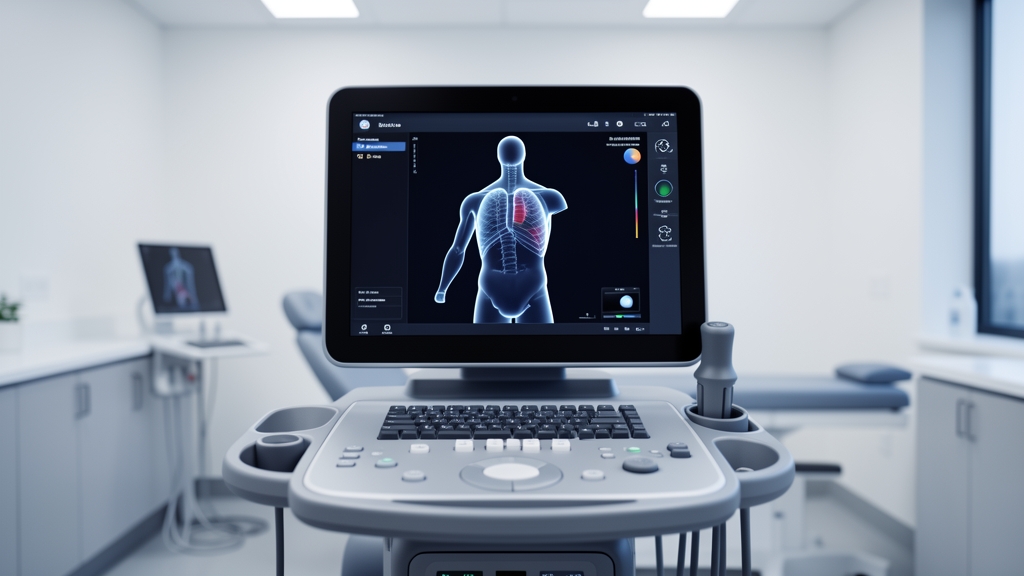
The boundary between generative art and clinical diagnostic tools is blurring faster than the medical establishment anticipated. Midjourney, the name synonymous with the explosion of latent diffusion models, is pivoting its expertise from pixel-perfect aesthetics to something far more high-stakes: the human anatomy.
The rollout of Midjourney’s Whole Body Ultrasound (WBU) system represents one of the most ambitious applications of generative AI in healthcare to date. Rather than traditional ultrasound, which relies on the real-time reflection of sound waves to create grainy, operator-dependent images, the WBU system uses proprietary generative models to "fill in the blanks." By analyzing low-fidelity acoustic data, the system reconstructs high-resolution, volumetric anatomical maps that look more like MRI scans than traditional ultrasound.
It is a feat of engineering that, on paper, should change everything. But as the dust settles on the initial technical demonstrations, the medical community is offering a nuanced, cautious response.
The Tech: Bridging the Acoustic Gap
To understand the controversy, one must understand the mechanism. Traditional ultrasound is limited by the physics of sound waves; deep tissue penetration often results in a loss of resolution. Midjourney’s approach treats ultrasound data as a "prompt." The system takes the raw, noisy acoustic input and passes it through a sophisticated neural network trained on massive datasets of paired ultrasound and CT/MRI scans.
The result is a "hallucinated" clarity—a reconstruction that provides a much more readable, continuous view of the body’s internal structures. For routine assessments, such as monitoring organ volume or checking for fluid accumulation, the WBU system is nothing short of transformative. It promises a level of speed and ease of use that could allow non-specialists to conduct preliminary scans in remote or underserved environments.
The Radiologist’s Verdict: Precision vs. Perception
However, the transition from "visual clarity" to "diagnostic accuracy" is where the friction lies. In a series of recent clinical discussions, leading radiologists have voiced significant concerns regarding the system's application in oncology.
The core issue is the "black box" nature of generative reconstruction. In radiology, the goal is not to see a beautiful image of a liver; the goal is to identify a microscopic irregularity in tissue density that could signal a malignancy. Critics argue that Midjourney’s generative process—while visually stunning—runs the risk of "smoothing over" the very anomalies that doctors need to see.
"There is a fundamental difference between a reconstruction that looks real and a reconstruction that is medically accurate," says one senior radiologist familiar with the system's beta testing. "In cancer screening, the 'noise' in an image is often where the truth lives. If the AI interprets a tiny, suspicious lesion as mere acoustic noise and 'cleans' it out of the final image to satisfy its training model, the tool becomes dangerous rather than helpful."
The consensus among experts is clear: the WBU system is currently not a substitute for whole-body cancer screening. The risk of false negatives—where a tumor is mathematically "reconciled" out of existence by a generative model—remains a prohibitive hurdle for oncological use.
The Hierarchy of Imaging
Despite these limitations, it would be a mistake to dismiss the WBU as a failure. Instead, it is shifting the hierarchy of medical imaging. The industry is beginning to view the WBU not as a competitor to the MRI or the CT scan, but as a sophisticated "triage" layer.
The strategic value of Midjourney’s technology lies in its accessibility and throughput. We are looking at a potential future where:
* Primary Care Triage: General practitioners use WBU for rapid, non-invasive checks of organ health, flagging only suspicious cases for high-resolution imaging.
* Emergency Response: Paramedics or rural clinicians can gain immediate, high-fidelity insights into internal trauma without the need for a heavy, expensive CT suite.
* Chronic Monitoring: Patients with known conditions can undergo frequent, low-cost monitoring of organ changes without the radiation exposure associated with repeated CT scans.
The Path Ahead
For Midjourney, the challenge is no longer about proving that their models can create realistic images; it is about proving they can maintain "clinical fidelity." The company faces a steep climb in regulatory validation, specifically in proving to bodies like the FDA that their generative layers do not introduce artifacts or erase critical pathological data.
As the technology matures, the goal won't be to replace the specialist's eye, but to augment the reach of the diagnostic process. The WBU system is a powerful tool, but in the high-stakes world of cancer detection, the truth lies in the details—not just the resolution.