The Death of the VRAM Wall: AMD’s Strix Halo and the Democratization of Large-Scale AI
For the past several years, the frontier of local Artificial Intelligence has been guarded by a singular, expensive gatekeeper: Video RAM (VRAM). If you wanted to run a Large Language Model (LLM) with significant reasoning capabilities—the kind that approaches human-level nuance—you needed massive amounts of high-speed memory. For enthusiasts and researchers, this meant building expensive workstations packed with multiple high-end GPUs, often costing upwards of $5,000 or more to achieve the necessary memory capacity.
That barrier has just been breached.
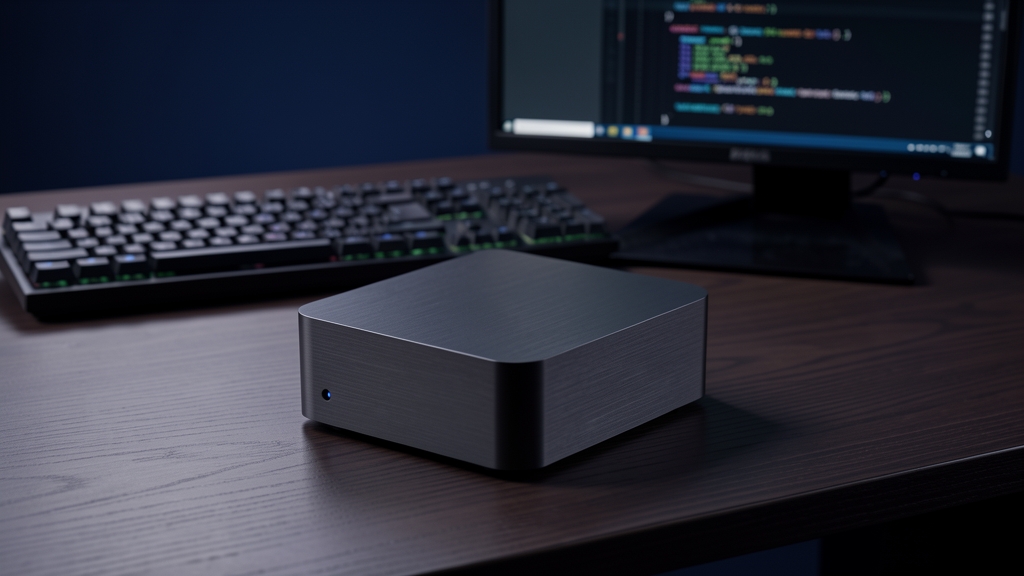
AMD has officially unveiled its Strix Halo-based mini PC, a compact powerhouse that is sending shockwaves through the hardware community. Priced at a staggering $1,500, the machine features a massive 128GB of unified memory. While the price point is competitive for a high-end workstation, the real story lies in the architecture: this single device can run 120B parameter models locally, a feat previously reserved for enterprise-grade hardware.
The Architecture of Disruption: Unified Memory
To understand why this matters, one must understand the "VRAM Wall." In a traditional PC architecture, the CPU and the GPU are separate entities. The CPU handles general tasks and uses system RAM, while the GPU handles graphics and AI workloads using its own dedicated VRAM. When running massive AI models, the model's "weights" must reside in the VRAM. If the model is larger than the available VRAM, the system must swap data to much slower system RAM, causing performance to crater.
AMD’s Strix Halo approach pivots away from this fragmentation. By utilizing a unified memory architecture—similar to the philosophy employed by Apple’s M-series silicon but within the x86 ecosystem—the Strix Halo allows the GPU to access the entire 128GB pool.
This is a seismic shift. A 120B parameter model, when quantized to 4-bit or 5-bit precision to make it efficient, requires roughly 70GB to 90GB of memory to run smoothly. On a standard consumer gaming PC with a 24GB RTX 4090, this is an impossible task without extreme compromises. On the Strix Halo, it is a routine operation.
Breaking the Math: Why 120B Parameters Matter
In the AI landscape, parameter count is often a proxy for "intelligence." Small models (7B to 14B parameters) are fast and efficient but often struggle with complex logic, long-term memory, and nuanced instruction following. Mid-sized models (30B to 70B) are the current sweet spot for many enthusiasts. However, the "frontier" models—those capable of truly sophisticated reasoning—tend to live in the 100B+ range.
By enabling 120B parameter models on a $1,500 device, AMD is effectively moving the "intelligence ceiling" from the data center to the desktop. Developers can now iterate on highly complex models, test advanced agentic workflows, and maintain total data privacy without needing a subscription to a cloud-based API or a rack of enterprise GPUs.
The Market Impact: A Direct Challenge to NVIDIA
For a long time, NVIDIA has enjoyed a near-monopoly on the high-end AI compute market. Their CUDA ecosystem is the industry standard, and their hardware is the gold standard. However, NVIDIA’s consumer-grade cards are strictly limited by their VRAM capacity. To get 128GB of VRAM through NVIDIA today, a user would likely need to purchase multiple professional-grade cards or a high-end data center GPU, pushing the price well into the tens of thousands of dollars.
AMD is attacking this from a different angle: efficiency and price-to-capacity. They aren't trying to out-compute NVIDIA in raw TFLOPS (Teraflops) for training; they are aiming to dominate the inference market. Inference—the act of actually running a model once it has been trained—is where the vast majority of consumer and enterprise use will eventually live. By providing a massive "memory bucket" at a fraction of the cost of a professional GPU setup, AMD is making a compelling case for the "Local AI Workstation."
Technical Caveats and the Road Ahead
While the implications are massive, the Strix Halo is not without its hurdles. The primary challenge for any unified memory system is memory bandwidth. For a GPU to perform effectively with 128GB of data, it needs to move that data incredibly fast. If the bandwidth is too low, the "intelligence" of the 120B model will be offset by agonizingly slow token generation speeds.
Industry analysts are watching closely to see how AMD’s implementation of LPDDR5X or specialized memory controllers manages this bottleneck. Furthermore, the thermal management of fitting such a high-performance chip into a "mini PC" form factor will be a critical test of the design.
However, even if the token-per-second speed is lower than a multi-GPU enthusiast build, the sheer accessibility of these models is the real victory. The Strix Halo represents a move toward a world where the most powerful AI models are no longer locked behind a cloud paywall, but are sitting right on your desk.
The Verdict
The Strix Halo mini PC is more than just a piece of hardware; it is a statement of intent. AMD is betting that the future of AI isn't just in the cloud, but in the hands of individuals, researchers, and developers who demand privacy, control, and massive memory capacity. If they can nail the bandwidth and thermal requirements, the $1,500 price tag might just mark the beginning of the end for the era of VRAM scarcity.