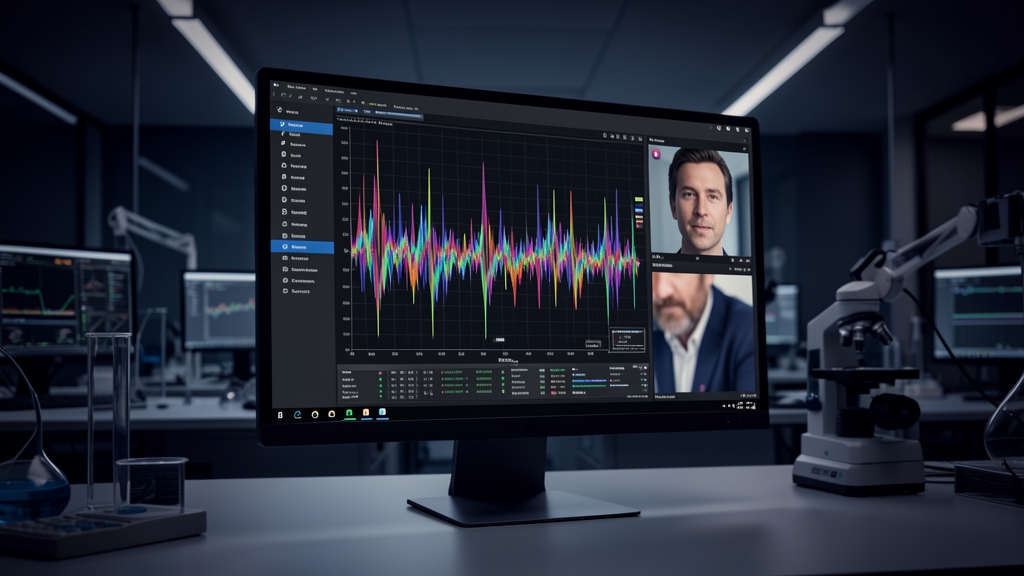
Beyond the Uncanny Valley: New Research Decodes the Digital Fingerprints of AI-Generated Video
For years, the conversation around generative artificial intelligence has been dominated by a single, looming question: Is this real? As video diffusion models evolve, the "uncanny valley"—that unsettling feeling when a digital human looks almost, but not quite, human—is rapidly disappearing. We are entering an era where the human eye, and even traditional detection algorithms, are no longer reliable arbiters of truth.
However, a significant breakthrough from a computer science team led by researchers at UC is shifting the paradigm. They are no longer just asking if a video is synthetic; they are asking which machine made it. This shift from mere detection to "source attribution" represents a fundamental change in digital forensics, providing a way to trace the lineage of deepfakes back to their specific algorithmic origins.
The Evolution of Deception
The current landscape of synthetic media is a battlefield of rapid escalation. High-fidelity models can now generate coherent motion, realistic lighting, and perfect skin textures that defy standard scrutiny. In the past, detection methods relied on spotting "glitches"—a blinking eye that doesn't sync, a strange shadow, or a warping background.
But as generative adversarial networks (GANs) and diffusion models become more sophisticated, these errors are being engineered out of existence. The problem is no longer about visual artifacts; it is about the mathematical fabric of the video itself.
The UC research team's new tool approaches the problem from this mathematical perspective. Instead of looking for visual mistakes, the tool analyzes the "fingerprints" left behind by the underlying architecture of the AI model.
The Science of Spectral Fingerprints
At the heart of this breakthrough is the concept of architectural signatures. Every generative model, whether it is a transformer-based video generator or a latent diffusion model, processes data in a unique way. During the denoising process—the method by which many modern AIs turn random noise into a structured image—the model leaves behind subtle, rhythmic patterns in the high-frequency spectrum of the video.
To a human viewer, these patterns are invisible. Even to a standard video compressor, they appear as normal data. However, by utilizing Fourier transform analysis, the researchers can examine the frequency domain of the footage. They have discovered that different models produce distinct "spectral fingerprints."
Key technical aspects of the methodology include:
* Latent Space Residuals: Identifying the specific ways a model navigates its internal mathematical space to resolve pixels.
* Noise Correlation Patterns: Detecting the unique stochastic noise patterns inherent to specific diffusion processes.
* Up-sampling Artifacts: Tracing the specific mathematical shortcuts used by different models to increase video resolution.
By training a deep-learning classifier on these sub-perceptual patterns, the team has developed a tool capable of distinguishing between videos produced by different proprietary and open-source models with startling accuracy.
The Stakes: Geopolitics and the "Liar's Dividend"
The implications of this technology extend far beyond the tech enthusiast community. We are currently witnessing the rise of the "Liar's Dividend"—a phenomenon where the mere existence of deepfakes allows bad actors to claim that authentic, incriminating footage is actually fake. When anything can be faked, nothing is inherently believable.
By providing a way to attribute video to a specific source, this tool offers a path toward accountability. If a piece of disinformation targeting a global election can be traced back to a specific, known model architecture, it provides investigators, journalists, and intelligence agencies with a vital piece of the evidentiary puzzle. It moves the conversation from "This might be fake" to "This was generated by Model X, which is widely used by Group Y."
The Infinite Arms Race
Despite the promise of this new tool, the tech industry remains locked in an escalating arms race. History shows that as soon as a new detection method is popularized, developers of generative models often incorporate that very detection method into their training loops. This is known as "adversarial training."
If a generative model is trained with the goal of minimizing the specific spectral fingerprints identified by the UC researchers, the tool's effectiveness could diminish. This creates a perpetual cycle of innovation: researchers find a signature, model developers mask the signature, and researchers find a deeper, more subtle signature.
A New Standard for Digital Trust
The emergence of source attribution marks a mature phase in the AI era. We are moving past the initial shock of synthetic media and toward a structured framework for managing it. For industries like legal services, news media, and cybersecurity, the ability to verify the provenance of digital content is becoming as essential as the ability to verify a physical signature.
While no tool can offer an absolute guarantee of truth in an age of infinite synthesis, the ability to decode the machine's work provides a necessary layer of defense. The UC researchers haven't just built a detector; they have built a way to hold the machines—and those who use them—to a higher standard of accountability.