For much of the early 21st century, the definition of "innovation" became increasingly intangible. The giants of the era were built on lines of code, social algorithms, and the seamless delivery of cloud services. Success was measured in user engagement, monthly active users, and the ability to scale software across borders with near-zero marginal cost. But as the nation nears its 250-year milestone, a profound realization is settling over Silicon Valley, the Rust Belt, and the research hubs of the Ivy League: software, while transformative, is no longer enough.
The central thesis of America's technological legacy is not found in any single patent or product, but in a recurring cultural impulse to build. From the steam engines of the industrial revolution to the silicon wafers that defined the digital age, the most significant leaps have been driven by the convergence of theoretical brilliance and massive, physical-scale execution. Today, we are witnessing the dawn of a new cycle—one that moves beyond the screen and back into the physical world.
The Era of "Atoms over Bits"
The current tech landscape is undergoing a massive pivot from "bits" to "atoms." While the last two decades focused on optimizing the digital experience, the next era is being defined by deep-tech sectors that require massive capital expenditure and complex engineering. This is the era of the "Hard Tech" renaissance.
We see this shift manifesting in several critical domains:
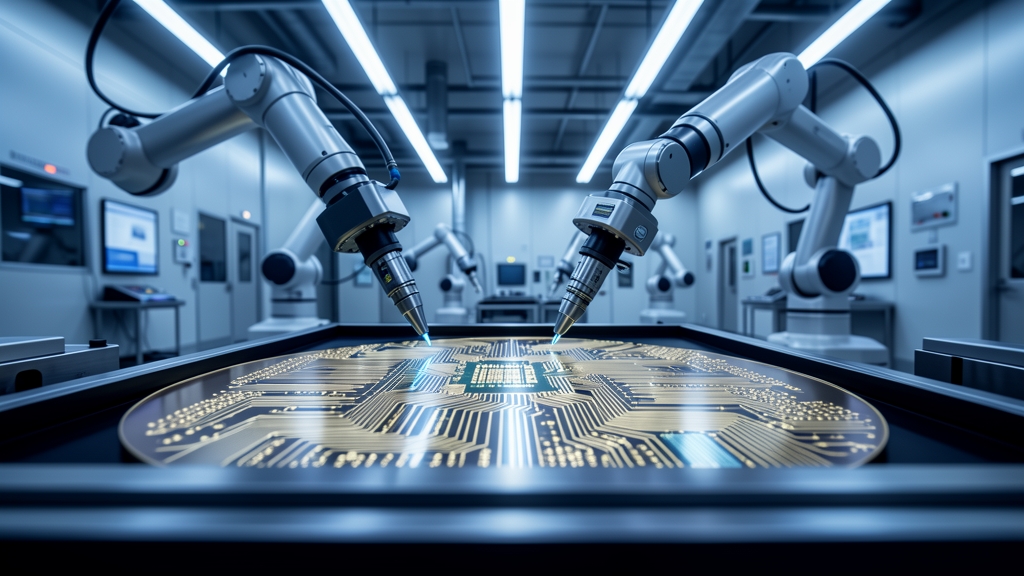
* The Semiconductor Renaissance: The realization that the entire digital world rests on a fragile, highly centralized supply chain has triggered a massive push for domestic high-end logic chip manufacturing. This isn't just about making chips; it's about reclaiming the sovereignty of the hardware layer.
* The Energy Transition: Innovation is moving from the app-based "smart home" to the macro-scale engineering of nuclear fusion, advanced geothermal systems, and next-generation grid storage. The winners of the next decade will not be those who build the best energy-tracking app, but those who master the physics of carbon-free power.
* The Bio-Convergence: We are seeing the integration of computational power with biological engineering. CRISPR, synthetic biology, and personalized medicine represent a shift where code is used to rewrite the fundamental hardware of life itself.
* The New Space Race: Space is no longer the exclusive playground of government agencies. The democratization of low-earth orbit via reusable launch vehicles is creating a new economic layer that connects the terrestrial to the orbital.
The Intelligence-to-Physicality Pipeline
At the heart of this transition lies Artificial Intelligence. For several years, the conversation around AI was almost entirely focused on Large Language Models (LLMs) and generative creativity—the ability to produce text, images, and code. However, the true endgame of the AI revolution is not a smarter chatbot; it is the integration of intelligence into physical systems.
The "intelligence-to-physicality" pipeline describes the process where AI-driven reasoning is applied to robotics, autonomous manufacturing, and material science. We are moving toward a reality where AI doesn't just write a poem; it designs a more efficient turbine blade, optimizes the chemical composition of a new battery, or manages the complex logistics of a fully automated micro-factory. This is where the software of the last era becomes the foundational tool for the hardware of the next.
Navigating the Complexity of Scale
Transitioning from a software-centric economy to a deep-tech industrial economy is not without significant friction. Software scales linearly and cheaply; hardware scales exponentially and expensively. The challenges are structural:
1. Capital Intensity: Deep tech requires "patient capital." Venture capital models designed for high-margin SaaS (Software as a Service) are often ill-equipped for the long R&D cycles and heavy CAPEX (Capital Expenditure) required by fusion energy or semiconductor fabs.
2. The Talent Gap: The world needs a new class of "full-stack" innovators—engineers who are equally comfortable with Python and thermodynamics, or data scientists who understand the nuances of fluid dynamics.
3. Regulatory Lag: Our regulatory frameworks were built for a world of digital services. Applying these same frameworks to autonomous vehicles, synthetic biology, or orbital debris management requires a fundamental rethink of how we manage risk and progress.
The 250-Year Pivot
The strength of American innovation has historically been its ability to reinvent its own foundation. When the frontier moved from the land to the factory, the country adapted. When it moved from the factory to the computer, it led the way.
As we look toward the next era, the challenge is to move beyond the digital abstractions that have defined the recent past. The next era of American innovation will be measured by the strength of our power grids, the sophistication of our silicon, and the resilience of our manufacturing chains. It will be a period defined not by how well we can capture attention on a screen, but by how effectively we can engineer the physical world to meet the demands of a complex, high-energy future. The ability to build is returning to the center of the stage.