The New Industrial Frontier: Palantir’s Vision for Sovereign AI and the Rebirth of American Manufacturing
By AutoKeren Staff
In the heart of the Pennsylvania defense corridor, the conversation is no longer about whether artificial intelligence will change the world, but how quickly it can rebuild it. Speaking at the 2026 Pennsylvania Defense and Innovation Summit, Palantir CTO Shyam Sankar laid out a provocative roadmap that positions AI not merely as a software upgrade, but as the fundamental operating system for both modern warfare and domestic industrial resurgence.
Joined by CNBC’s Morgan Brennan, Sankar’s remarks moved beyond the standard Silicon Valley hype cycles. Instead, he focused on the "hard tech" realities: the intersection of kinetic defense, sovereign computing, and the massive logistical undertaking of reindustrializing the American economy.
The Algorithmic Battlefield
The most immediate implication of Sankar’s thesis lies in the evolution of defense. For decades, military superiority was measured by kinetic force—the weight of explosives and the speed of aircraft. However, as Sankar argues, the modern theater of war is increasingly defined by the speed of the "decision loop."
AI is no longer a peripheral tool used for post-hoc analysis; it is now a real-time force multiplier. In high-intensity environments, the ability to fuse disparate data streams—satellite imagery, electronic signals, and ground-level sensor data—into a single, actionable operating picture is the difference between tactical success and catastrophic failure.
The shift is toward "autonomous intelligence," where AI systems assist in identifying patterns and threats at speeds that human operators simply cannot match. This isn't about replacing human command, but about augmenting it, ensuring that decision-makers are acting on the most accurate, distilled reality possible in a landscape of mounting disinformation and rapid technological escalation.
The Doctrine of Sovereign AI
Perhaps the most significant technical and political concept discussed was "Sovereign AI." In an era of globalized supply chains and interconnected digital infrastructures, Sankar posits that true national security is impossible without control over the entire AI stack.
Sovereign AI refers to a nation’s ability to develop, host, and govern its own artificial intelligence capabilities without reliance on foreign-controlled clouds, proprietary models, or opaque data silos. The risks of dependency are twofold:
* Data Privacy and Integrity: If a nation relies on external AI models, it risks leaking its most sensitive strategic data into training sets controlled by foreign entities.
* Operational Continuity: In a conflict scenario, access to critical AI infrastructure could be severed by geopolitical adversaries, rendering a nation’s most advanced defense systems inert.
For Sankar, the goal is a self-contained ecosystem where the hardware, the foundational models, and the application layers are all under domestic, sovereign control. This creates a "walled garden" of intelligence that is both unassailable and inherently trusted.
Reindustrialization: The Marriage of Software and Steel
While the defense implications are stark, Sankar’s most ambitious claim concerns the domestic economy. He suggests that the same AI architectures used to navigate a battlefield can be deployed to solve the chronic inefficiencies that have hollowed out American manufacturing.
The concept of "reindustrialization" through AI rests on three technical pillars:
1. Predictive Supply Chain Resilience: Moving from reactive logistics to proactive modeling. AI can simulate global disruptions—from weather events to geopolitical shifts—allowing manufacturers to reroute resources before a shortage occurs.
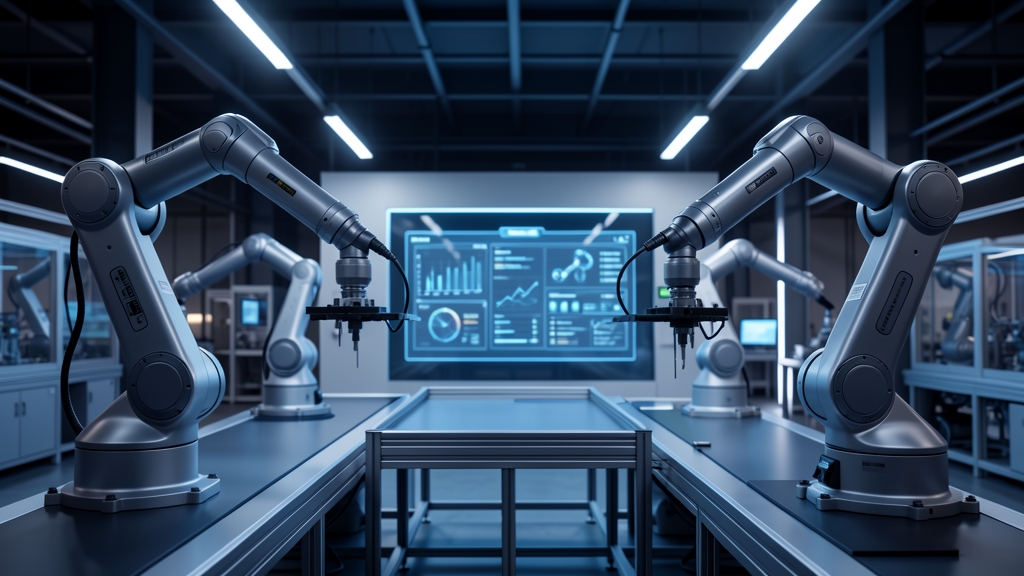
2. The Digital Twin of the Factory Floor: By integrating AI with IoT (Internet of Things) sensors, companies can create high-fidelity digital replicas of entire production lines. This allows for "edge computing" where machines self-diagnose failures and optimize energy consumption in real-time, drastically reducing downtime and waste.
3. Bridging the Labor Gap: As the workforce shifts, AI-driven automation can handle high-precision, repetitive, or dangerous tasks, allowing human workers to move into high-level supervisory and maintenance roles, effectively "upskilling" the industrial sector through digital assistance.
This isn't just about building smarter robots; it is about creating an "intelligent" industrial base. Sankar envisions a future where the American factory is a data-driven organism, capable of pivoting production lines with the speed of a software update.
The Convergence of Two Worlds
The core takeaway from the summit is the blurring of the line between the commercial and the tactical. The enterprise strategy of the future is increasingly being written by defense requirements. Companies that can master the complexity of large-scale, high-stakes data environments in the defense sector are uniquely positioned to lead the next wave of industrial automation.
As the summit concluded, the sentiment was clear: the next decade will be defined by the race to master this convergence. The winners will not just be those with the best algorithms, but those who can successfully weave those algorithms into the physical fabric of ships, tanks, factories, and power grids. The era of "pure software" is ending; the era of "intelligent physical systems" has begun.