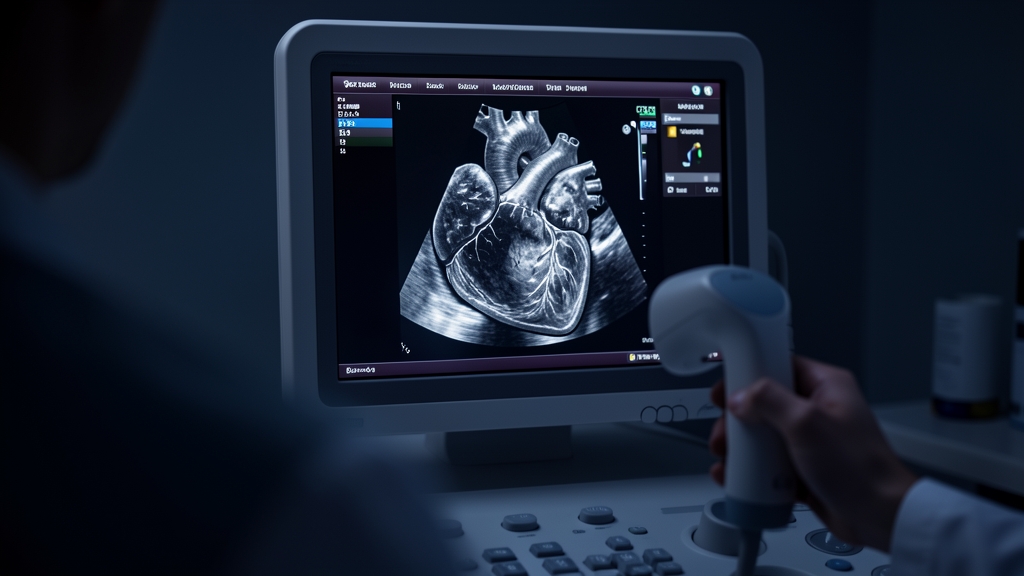
=== The Limitations of Sound ===
For decades, ultrasound has occupied a unique, albeit imperfect, niche in the medical diagnostic toolkit. Unlike the high-resolution, static snapshots provided by Magnetic Resonance Imaging (MRI) or Computed Tomography (CT), ultrasound is dynamic, real-time, and incredibly versatile. It is the frontline tool for prenatal care, cardiac monitoring, and emergency triage.
However, ultrasound has a persistent Achilles' heel: image quality is notoriously fickle. The clarity of a sonogram depends heavily on the skill of the technician, the physical anatomy of the patient, and the quality of the transducer. "Noise," acoustic shadowing, and artifacts often obscure the very details clinicians need to make life-altering decisions. Until now, improving these images required increasingly expensive hardware and higher-frequency transducers—solutions that are not always scalable or accessible in low-resource environments.
That paradigm is shifting. Researchers are now moving beyond simple signal processing, turning instead to the transformative power of generative artificial intelligence to reconstruct, enhance, and refine medical imagery in real-time.
=== The Generative Leap ===
The core of this breakthrough lies in the application of generative models—specifically architectures like Diffusion Models and Generative Adversarial Networks (GANs)—to the complex task of medical image reconstruction.
Traditional ultrasound imaging relies on the physics of sound waves bouncing off tissue. When those waves encounter air, bone, or complex tissue interfaces, the resulting image is often grainy or "noisy." Standard filters attempt to smooth this noise, but they often do so at the cost of losing critical diagnostic details, such as the subtle texture of a lesion or the precise boundary of a vessel.
Generative AI approaches the problem differently. Rather than merely filtering out noise, these models are trained on massive datasets of paired images: low-quality, noisy scans and high-quality, "ground truth" scans (often captured via more expensive imaging modalities). Through this training, the AI learns the underlying statistical distribution of what healthy and pathological tissue should look like.
When presented with a noisy, real-time sonogram, the generative model performs a sophisticated act of "informed reconstruction." It identifies the noise patterns and uses its learned understanding of anatomy to synthesize a cleaner, sharper image that maintains high structural fidelity. This isn't just "upscaling" in the consumer sense; it is a mathematically grounded reconstruction of biological reality.
=== Technical Precision vs. The Hallucination Risk ===
In the world of generative AI, there is a persistent specter: the "hallucination." In consumer tools like Midjourney or DALL-E, a hallucination might result in a person having six fingers—a visual quirk that is harmless in art but catastrophic in medicine. In a clinical setting, a generative model that "invents" a clear vessel where none exists, or inadvertently "smooths over" a tiny, malignant tumor to make the image look cleaner, poses a direct threat to patient safety.
This is the primary technical hurdle currently facing researchers. To bridge the gap from laboratory breakthrough to clinical standard, these models must be "fidelity-constrained."
Current research is focusing on integrating physics-based constraints into the neural network architecture. Instead of allowing the AI complete creative freedom, researchers are forcing the model to adhere to the laws of acoustics and the specific raw data captured by the transducer. By ensuring that the generated output remains mathematically tethered to the original ultrasound signals, the risk of "creating" non-existent anatomy is significantly mitigated.
=== Democratizing High-End Diagnostics ===
The market implications of smarter sonograms extend far beyond the walls of elite teaching hospitals. If software can compensate for hardware limitations, the entire economics of medical imaging changes.
1. Hardware Agnosticism: High-end, premium ultrasound machines cost hundreds of thousands of dollars. If generative AI can extract "premium" image quality from mid-range or even handheld devices, the barrier to entry for high-quality diagnostics drops precipitously.
2. The Skill Gap Bridge: Ultrasound is highly operator-dependent. An experienced sonographer can navigate complex anatomy with ease, while a novice may struggle to find the right angle. Generative AI can act as a real-time "intelligent assistant," enhancing the view and guiding the technician toward the most diagnostic-quality image.
3. Global Health Impact: In rural or developing regions, where access to MRI and CT is non-existent, a handheld, AI-enhanced ultrasound device could provide diagnostic capabilities that were previously unimaginable.
=== The Road Ahead ===
As we move deeper into the integration of AI and medical imaging, the focus is shifting from "can we do this?" to "how do we validate this?" Regulatory bodies like the FDA are increasingly scrutinizing the "black box" nature of deep learning models. For generative AI to become a staple in every clinic, developers must provide transparency regarding how these models make decisions and demonstrate rigorous, peer-reviewed evidence of their accuracy across diverse patient populations.
The transition from "noisy sonograms" to "intelligent imaging" is not merely an incremental upgrade; it is a fundamental reimagining of how we see inside the human body. By turning sound into high-definition data, generative AI is helping clinicians see more clearly than ever before.