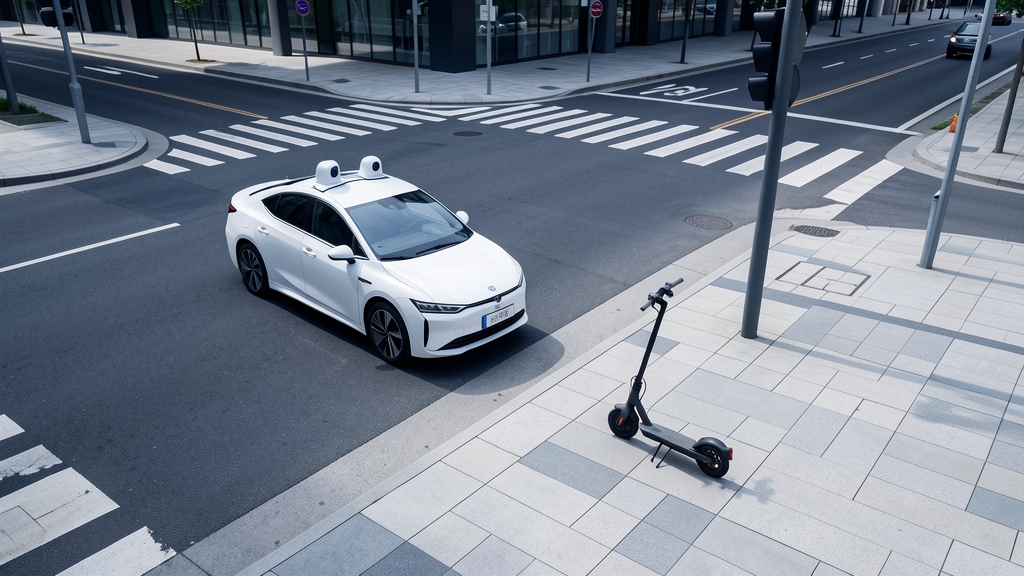
The streets of Harrisburg are currently serving as a living laboratory for the next evolution of human and logistical movement. At the Transportation Tech Showcase, the atmosphere is less about individual gadgets and more about a profound structural shift in how cities function. This isn't just a collection of disparate demos; it is a preview of a unified "Mobility-as-a-Service" (MaaS) paradigm that seeks to bridge the gap between heavy transit and the final doorstep.
The showcase brings together three distinct pillars of modern movement: high-level autonomous driving, electric micro-mobility, and automated last-mile logistics. By observing the demonstrations from Waymo, Lime, and DoorDash, a clear pattern emerges: the future of transportation is not defined by the vehicle itself, but by the digital and physical interoperability of the entire network.
Waymo: The Foundation of Autonomous Reliability
At the center of the heavy-duty transit demonstrations is Waymo. While the industry has long been fascinated by the concept of self-driving cars, the focus here has shifted from "can it work?" to "how reliably can it scale?" Waymo’s presence in Harrisburg highlights the maturation of Level 4 autonomy.
The technical sophistication on display is centered on sensor fusion—the ability of the vehicle to synthesize data from LiDAR, radar, and high-resolution cameras into a single, coherent environmental model. In the complex, often unpredictable urban corridors of Harrisburg, Waymo’s hardware is proving its ability to navigate not just traffic, but the nuances of human behavior, such as a pedestrian stepping off a curb or a cyclist signaling a turn.
For the tech sector, the implication is clear: the software stack is reaching a level of granularity where the "driver" is no longer a human necessity, but a computational certainty. The market impact of this stability cannot be overstated; as Waymo proves its reliability in varied urban environments, the path toward commercial fleet integration becomes significantly clearer for municipalities.
Lime: Solving the Interstitial Gap
If Waymo represents the backbone of urban transit, Lime represents its circulatory system. Micro-mobility has often been criticized for being a "fragmented" solution—scooters that appear and disappear without contributing to a cohesive transit strategy. However, the Lime demonstrations in Harrisburg suggest a move toward deeper integration.
The focus here is on the "interstitial gap"—the distance between a major transit hub and a user's final destination. Lime is showcasing advancements in battery density and swappable power units, which are critical for maintaining fleet uptime in a high-demand environment. By optimizing the energy efficiency of their electric fleets, Lime is addressing the primary critique of micro-mobility: its carbon footprint and logistical overhead.
The technical narrative for Lime is one of data-driven deployment. Through advanced predictive analytics, the fleet is positioned in anticipation of demand, transforming from a collection of scattered scooters into a responsive, intelligent layer of the city's infrastructure.
DoorDash: The Automated Last Mile
The third pillar, represented by DoorDash, addresses the most expensive and logistically challenging segment of the supply chain: the last mile. While DoorDash has built its reputation on human-driven delivery, the showcase highlights a pivot toward autonomous delivery units—small, sidewalk-based robots designed to navigate pedestrian environments.
The challenge for DoorDash is one of computer vision and edge computing. These delivery bots must operate in high-density pedestrian areas, identifying obstacles in real-time while maintaining precise navigation without the benefit of high-speed GPS accuracy found in larger vehicles. The integration of AI-driven routing allows these units to weave through urban chaos, turning the "last mile" from a logistical bottleneck into a streamlined, automated process.
The Convergence: A Unified Urban Operating System
The most significant takeaway from the Harrisburg showcase is the realization that these three technologies are not competing for the same space; they are occupying different layers of the same stack.
In a fully realized ecosystem:
* Waymo handles the high-capacity, mid-to-long distance transit of people and goods.
* Lime provides the agile, individual movement for the short-range "micro-trips."
* DoorDash automates the granular, doorstep-to-doorstep delivery of goods.
The synergy between these players suggests the emergence of an "Urban Operating System." In this model, a user might take an autonomous Waymo shuttle to a central hub, hop on a Lime scooter to reach their office, and receive an automated DoorDash delivery at their desk—all managed through a single, interconnected digital interface.
The Road Ahead: Infrastructure and Regulation
Despite the technical triumphs on display, significant hurdles remain. The convergence of these technologies demands a rethink of urban planning. Cities will need "smart" infrastructure—dedicated lanes for micro-mobility, charging hubs for electric fleets, and sensor-equipped intersections that can communicate with autonomous vehicles.
Furthermore, the regulatory landscape remains a patchwork of local and national laws. For the vision presented in Harrisburg to become a global standard, policymakers must move as fast as the engineers. The question is no longer whether the technology works, but whether our cities are ready to host it.
The Harrisburg Transportation Tech Showcase has provided a glimpse into a world where movement is no longer a series of disconnected journeys, but a continuous, optimized flow. For the tech enthusiasts and urban planners watching, the message is loud and clear: the era of fragmented transit is ending, and the era of the integrated network has begun.