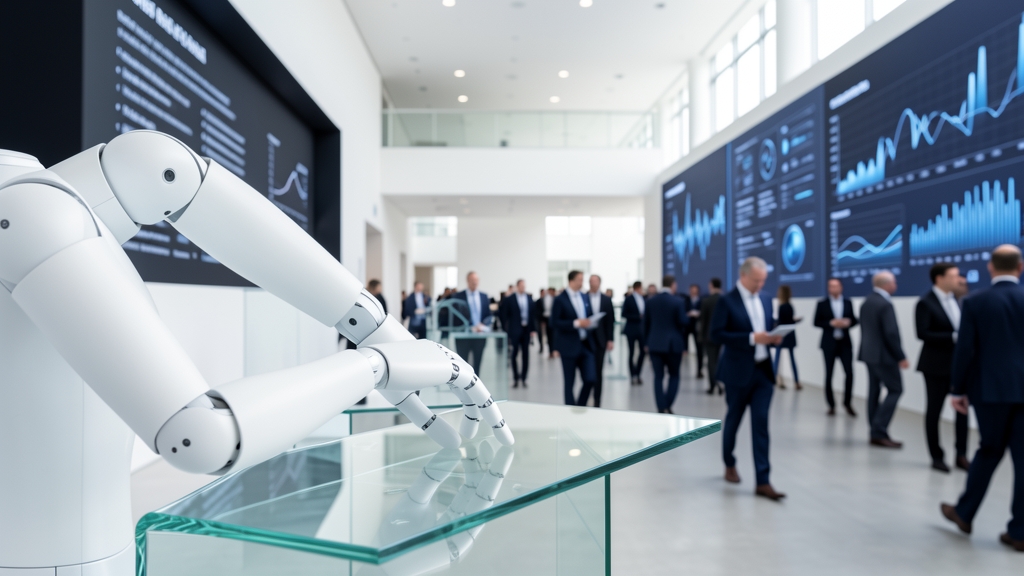
The atmosphere at the opening of the World Artificial Intelligence Conference (WAIC) is electric, but the sentiment is noticeably different from the speculative fever of previous years. There is a palpable sense of transition. The era of being "wowed" by a chatbot that can write a poem or generate a surreal image is over. Today, the conversation has shifted toward utility, agency, and integration.
Under the theme "AI Partnership for a Brighter Future," WAIC serves as the definitive litmus test for where artificial intelligence stands in the current global economy. The message from the floor is clear: we are moving from AI as a digital novelty to AI as a functional, autonomous partner in both the digital and physical realms.
The Rise of the Agentic Era
If the previous cycle of AI development was defined by "Generative AI"—the ability to create content from text—this year is being defined by "Agentic AI." The distinction is subtle but profound. While a generative model responds to a prompt, an AI agent pursues a goal.
Throughout the exhibition halls, the focus is on systems capable of multi-step reasoning and tool use. We are seeing the emergence of sophisticated autonomous agents designed to navigate complex software environments, manage supply chains, and execute intricate research workflows without constant human hand-holding. These agents do not just suggest an itinerary; they book the flights, manage the calendar invites, and adjust for real-time delays.
This shift represents a massive leap in the economic value proposition of AI. For enterprises, the move toward agency means a reduction in the "human-in-the-loop" requirement, allowing AI to move from a co-pilot to a semi-autonomous worker. However, this brings a new set of challenges regarding reliability, error propagation, and the technical necessity for "verifiable reasoning" in large-scale deployments.
Embodied Intelligence: AI Gets a Body
Perhaps the most striking visual component of the conference is the convergence of advanced large models with high-fidelity robotics. This is the dawn of "Embodied Intelligence." For years, AI has lived behind glass screens, confined to the cloud and the browser. Today, that intelligence is being poured into silicon and steel.
The demonstration of humanoid robots at WAIC shows a level of dexterity and environmental awareness that was, until recently, relegated to science fiction. These machines are no longer running on hard-coded scripts; they are running on "World Models"—neural networks that understand the physics of the environment around them. They can perceive depth, predict the movement of objects, and learn physical tasks through observation rather than explicit programming.
This marriage of cognitive intelligence and mechanical capability has massive implications for manufacturing, logistics, and eventually, elder care and domestic assistance. The "Partnership" mentioned in the conference theme is literal here: humans and robots working side-by-side in shared spaces, requiring a level of safety and social intelligence that is currently the frontier of research.
The Infrastructure of Intelligence: Edge vs. Cloud
As the intelligence becomes more ubiquitous, the underlying architecture is undergoing a massive decentralization. While the massive compute clusters in the cloud remain the backbone of model training, the conference highlights a surging trend in "Edge AI."
With the demand for real-time responsiveness in autonomous vehicles and robotics, waiting for a round-trip to a data center is no longer viable. We are seeing a proliferation of highly efficient, specialized NPU (Neural Processing Unit) architectures designed to run sophisticated multimodal models locally on devices. This "on-device intelligence" is critical for privacy, latency, and the sheer scalability of the AI ecosystem.
The industry is also grappling with the energy requirements of this expansion. As models grow in capability, the focus on sustainable compute and more efficient training algorithms is no longer a peripheral concern—it is a core technical requirement for the industry's survival.
Geopolitics and the Governance of Partnership
Beyond the hardware and the code, WAIC is a significant stage for the discussion of AI governance. The concept of "Partnership" extends to the relationship between technological progress and societal stability.
As China continues to assert its position as a global leader in AI research and deployment, the tension between rapid innovation and the need for robust safety frameworks remains a central theme. The conference attendees are engaged in deep debates over standardizing AI ethics, ensuring data sovereignty, and creating international frameworks that can manage the risks of autonomous systems while fostering a collaborative global market.
The Verdict
WAIC 2026 makes one thing certain: the honeymoon phase of AI is over, and the era of implementation has begun. The industry is no longer asking if AI can change the world, but how it will be integrated into the very fabric of our physical and professional lives. We are witnessing the transition from a world where we talk to computers, to a world where computers act alongside us.